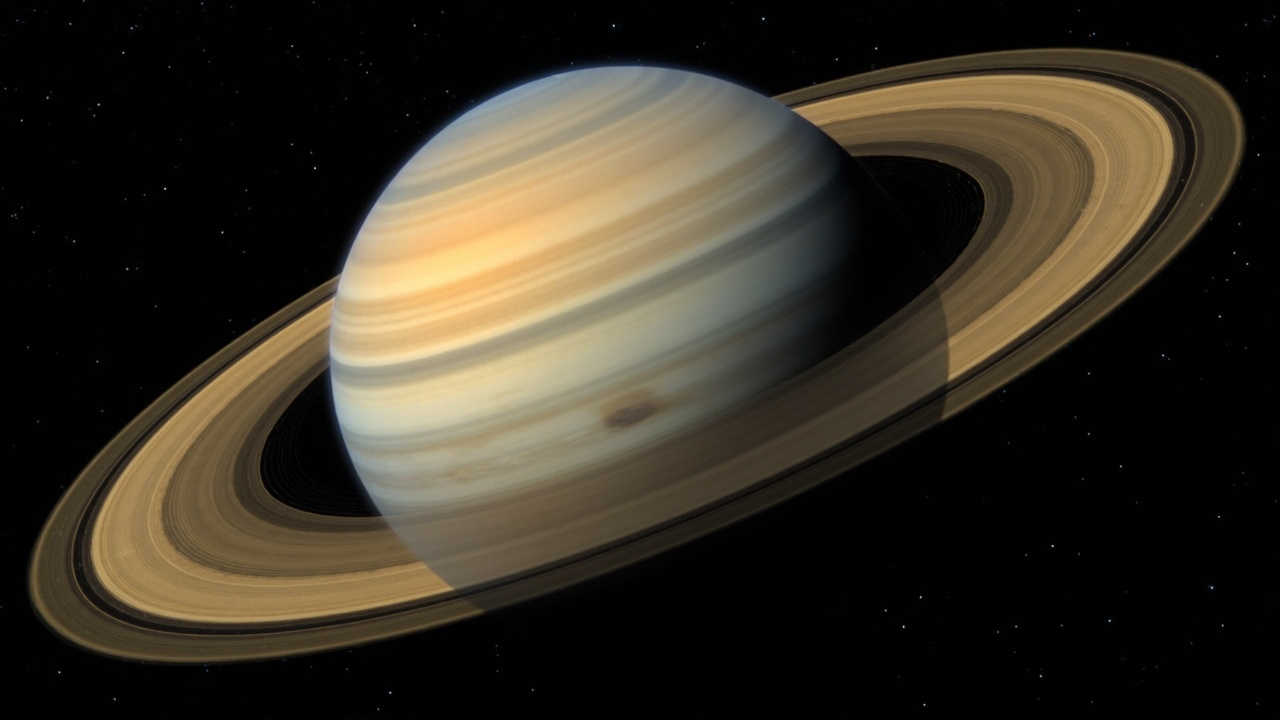
TL;DR: Hubble images show a giant ten-sided wave circling Saturn's south pole that sharpened from faint hints in 2023 into a clear decagon by 2025.
Astronomers using NASA's Hubble Space Telescope found a vast, evolving ten-sided atmospheric wave ringing Saturn's southern pole, a first-of-its-kind pattern for that hemisphere reported on Sept. 2, 2026 in the journal Science Advances, according to NASA's Hubble Tracks New Decagon Encircling Saturn's South Pole.
The study traces faint structure in 2023 to a sharply defined loop in August and September 2025 at planetographic latitudes near 58°S to 63°S. The work was led by Agustín Sánchez-Lavega of the University of the Basque Country with co-authors Amy A. Simon of NASA's Goddard Space Flight Center, Michael H. Wong of the University of California, Berkeley and colleagues at other institutions.
Researchers describe the feature as similar in spirit to Saturn's famous northern hexagon yet clearly distinct in shape, behavior and history. Where the northern six-sided jet has persisted on every look for more than 40 years, the southern ten-sided pattern appears to be strengthening and changing, offering a chance to watch a planetary-scale pattern take shape.
A southern counterpart at last
The northern hexagon has framed discussion of Saturn's poles since its identification in Voyager flybys in 1980-1981, according to the Science Advances paper A decagon wave around Saturn's south pole. That northern feature is centered near 78.5°N planetographic latitude and rides an intense eastward jet with peak speed near 100 meters per second while staying almost fixed in longitude relative to Saturn's System III radio rotation.
No comparable southern wave had been reported despite decades of watching, the paper reports. Because of Saturn's axial tilt, Earth-based viewing of the southern hemisphere ended in mid-2012 and did not return until 2023. NASA's Cassini spacecraft, which orbited Saturn between 2004 and 2017, showed no long-lived southern formation.
That absence made the new Hubble result notable. NASA characterizes the decagon as the first large, regular-sided jet pattern seen in the planet's southern hemisphere. The ten-sided geometry sits inside one of Saturn's powerful jet streams rather than as an isolated cloud streak.
How Hubble and ground telescopes caught it
The trail began on the ground. The University of the Basque Country operates the Planetary Virtual Observatory Laboratory, a site that accepts contributed images of Solar System planets from observers worldwide, NASA reports.
In those contributed images, Sánchez-Lavega and amateur astronomers Trevor Barry and Jean-Paul Oger noticed a subtle undulating band near the southern pole first in 2024. Additional ground-based imagery in 2025 pointed more strongly toward a decagonal structure.
Hubble then supplied the sharp, repeated coverage needed to test the idea. Its vantage above Earth's atmosphere avoids smearing by air turbulence and records full rotations of Saturn with consistent sharpness and spatial resolution.
The key dataset came from Hubble's Outer Planet Atmospheres Legacy program, known as OPAL, which has photographed the outer planets annually for more than a decade. By assembling OPAL views dating back to 2023, the team found early hints that grew into a clearly defined pattern.
In October 2023, Hubble red-filtered images at wavelengths longer than 600 nanometers already showed a ten-sided polygonal structure near 63°S planetographic latitude, the Science Advances paper reports. By August 2024, with a better viewing angle, sides and vertices were more visible although contrast varied with longitude. In August and September 2025, all ten vertices appeared fully developed, with three very prominent, four less prominent and three less defined.
Ground-based images from 2025 also captured the decagon, the paper reports.
Size, position and motion
The decagon is planetary in scale. The paper gives a mean zonal wavelength of 16,782 kilometers with an uncertainty of 1,100 kilometers for the wave-number-10 pattern. Edges of crests and troughs trace a sinusoidal wave with peak-to-peak latitudinal amplitude of 2.7 degrees plus or minus 0.3 degrees, equal to 2,645 kilometers.
Position depends on the wavelength used to view it. In red filters at 631, 727, 763 and 937 nanometers, the wave center lay at 63°S plus or minus 0.4 degrees, according to the paper. In the strong methane absorption band at 889 nanometers, the center appeared displaced equatorward at 60.5°S plus or minus 0.4 degrees.
Different Hubble filters probe different altitudes, NASA explains, so the small shift means the structure extends through multiple atmospheric layers. The agency describes it as a vertically extended structure rather than a shallow cloud-top marking.
The paper reports that the decagon moves eastward at 2.5 meters per second, far slower than the zonal jet at 60.5°S at 116 meters per second. Longitudes of its vertices oscillate with a period of 32 days and amplitudes from 4.6 degrees to 8.4 degrees.
A related but less defined decagonal undulation appears outside the main wave, the paper adds. At 763 nanometers it lay in a dark belt centered at 53°S in 2023 and 2024 and at 58°S in 2025. In 2025 it was also visible as a white band at 58.8°S in the 889-nanometer methane band. Those bands are about 2 to 3 degrees wide, or roughly 2,000 to 3,000 kilometers.
Why scientists think it formed recently
Co-author Amy Simon, OPAL principal investigator at NASA's Goddard Space Flight Center in Greenbelt, Maryland, said the team had never seen anything quite like this in Saturn's southern hemisphere, noting that the northern hexagon has been present on every look for more than 40 years while the new feature appears to be strengthening.
"The most intriguing part to me is that this seems to have just formed recently," Simon said. "The question is, why did it suddenly form now when we haven't seen one before?"
Lead author Sánchez-Lavega said the team has sought a southern counterpart to the northern hexagon in Hubble images since 1990, given symmetry in Saturn's north-south jet system. He said Cassini images from its 2004-2017 orbital tour gave no sign of a durable formation, while Hubble data confirmed the new feature's presence back to 2023.
Co-author Michael Wong, a researcher with the UC Berkeley Space Sciences Laboratory, said the change shows the value of repeated monitoring, adding, "A few years ago, this feature wasn't there," according to Decagon wave emerges near Saturn's south pole - UC Berkeley Space Sciences Lab.
That laboratory's account notes that Cassini in 2004 imaged the full southern hemisphere and found no hexagon, only short-lived perturbations in the circular east-to-west current band at 60.5°S that lasted no more than a few days and never reappeared before Cassini's planned atmospheric entry in 2017.
A possible trigger near 55°S
The paper proposes that the decagon could be a large-scale meandering wave trapped vertically and confined in latitude by curvature of the dominant jet. Shallow-water model simulations suggest two possibilities: a spatially periodic disturbance at the jet peak, or forcing by a dark anticyclonic vortex immediately to the north.
The neighboring vortex draws attention in the Berkeley account. A compact anticyclone near 55°S was first observed in 2023 and darkened sharply in 2025 just before the decagon became clear. That timing raises the possibility that the vortex supplied the initial perturbation and the surrounding balance of forces then sustained a persistent ten-sided shape.
Sánchez-Lavega developed a shallow-water equation model to explore how such a decagon could emerge in turbulent fluid, the Berkeley account reports. Much remains unresolved, including the makeup of aerosols giving the wave its blue appearance in processed views and the structure of the wave deeper in the atmosphere.
Visible portions of the wave lie in Saturn's upper troposphere, where associated winds reach about 400 kilometers per hour, the Berkeley account reports.
What OPAL's long watch makes possible
OPAL's yearly survey with Hubble's Wide Field Camera 3 underpins the finding. Saturn observations under that program began in 2018 after Cassini's end, following inspiration that traces to 2009 calibration work on the camera and later gaps with no Jupiter images in 2011 and 2013, the Berkeley account reports. Simon made the case for annual surveys of Jupiter, Saturn, Uranus and Neptune, and the program was approved.
Since then the survey has tracked several slow changes. In 2021 the OPAL team including Wong, Simon and Glenn Orton of NASA's Jet Propulsion Laboratory found increasing wind speeds in Jupiter's Great Red Spot. In 2023 the team found brightening over time in Uranus' northern polar hood. In July 2026 the team published observations covering a complete life cycle of a dark-spot cyclone on Neptune.
Wong said many OPAL discoveries rest on years of data rather than a single observation, adding that regular observations over time are enabling many new findings.
What comes next for Saturn's south pole
The authors say more work with Hubble and NASA's James Webb Space Telescope plus computer modeling is needed to learn how the decagon formed, how long it may endure and how it compares with the durable northern hexagon.
The team plans to keep observing Saturn to determine whether the southern wave settles into a durable, stable configuration like its northern counterpart or keeps evolving. Future views could also clarify what drives the wave, what it reveals about giant-planet atmospheric dynamics elsewhere in the Solar System and how those processes relate to patterns seen on Earth.