TL;DR: A year-long sequence of more than 50 lava fountains at Kīlauea has allowed forecasts of eruptions from summit tilt, while gas and rock data point away from a carbon-dioxide-foam trigger and toward shallow water-vapor and trapped-gas processes that remain incompletely understood.
Kīlauea's rare fountain sequence became a natural laboratory
Kīlauea has been erupting almost continuously for nearly 200 years, and volcanologists have watched many styles of activity at Hawaii's most active volcano, according to Science News. The volcano's recent fountain era kicked off at dawn on December 23, 2024, with an eruption inside the summit crater of Halemaʻumaʻu, according to Science News.
That sequence was unusual in its persistence. Before 2024, only three episodic fountaining eruptions had been documented at Kīlauea since 1823, according to the journal Science. The U.S. Geological Survey publication record for the new study describes the December 2024 eruption within Halemaʻumaʻu as producing 52 fountaining episodes to date, each lasting typically for hours and separated by days to weeks. By September 2026, the count had reached 54 episodes, the most recorded during any Kīlauea eruption, according to Science.
During an eruption, which can last from hours to days, months or even years, occasional lava fountains are not unusual, according to Science News. Repeated fountains — distinct bursts separated by minutes to weeks — during a single eruption are rare, according to Science News. At Kīlauea, those clustered spurts had occurred only three times since 1823, and never with such frequency, according to Science News.
Hotspot-driven volcanism is relatively sedate in most cases, with lava flowing down mountainsides slowly enough that people can walk out of its way, according to Ars Technica. In a number of locations — Mount Etna, Hawaii, Iceland — lava is expelled in dramatic fountains that can reach several hundred meters in height, according to Ars Technica.
Researchers from the U.S. Geological Survey described what was seen during the recent Kīlauea eruptions and compared it with expectations based on current ideas about what powers fountains of molten rock, in a recent edition of Science, according to Ars Technica. The paper, by Ashton Flinders, a research geophysicist at the U.S. Geological Survey's Hawaiian Volcano Observatory in Hilo, and colleagues, was published October 8 in Science, according to Science News. The study carries DOI 10.1126/science.aef2931, according to the U.S. Geological Survey publication record.
Decades of inflation set the stage for 2024
Previous work had identified a couple of lava reservoirs within a few kilometers of the surface at Kīlauea, according to Ars Technica. Following a major eruption in 2018 that partly drained one of the underground lava reservoirs, there were indications that it was being steadily refilled, according to Ars Technica.
Starting in 2019, that refill accelerated, and the local peak inflated at a rate of more than 22 cm a year, according to Ars Technica. Then, in 2023, that rate doubled to 57 cm a year, and spread to a nearby caldera, according to Ars Technica.
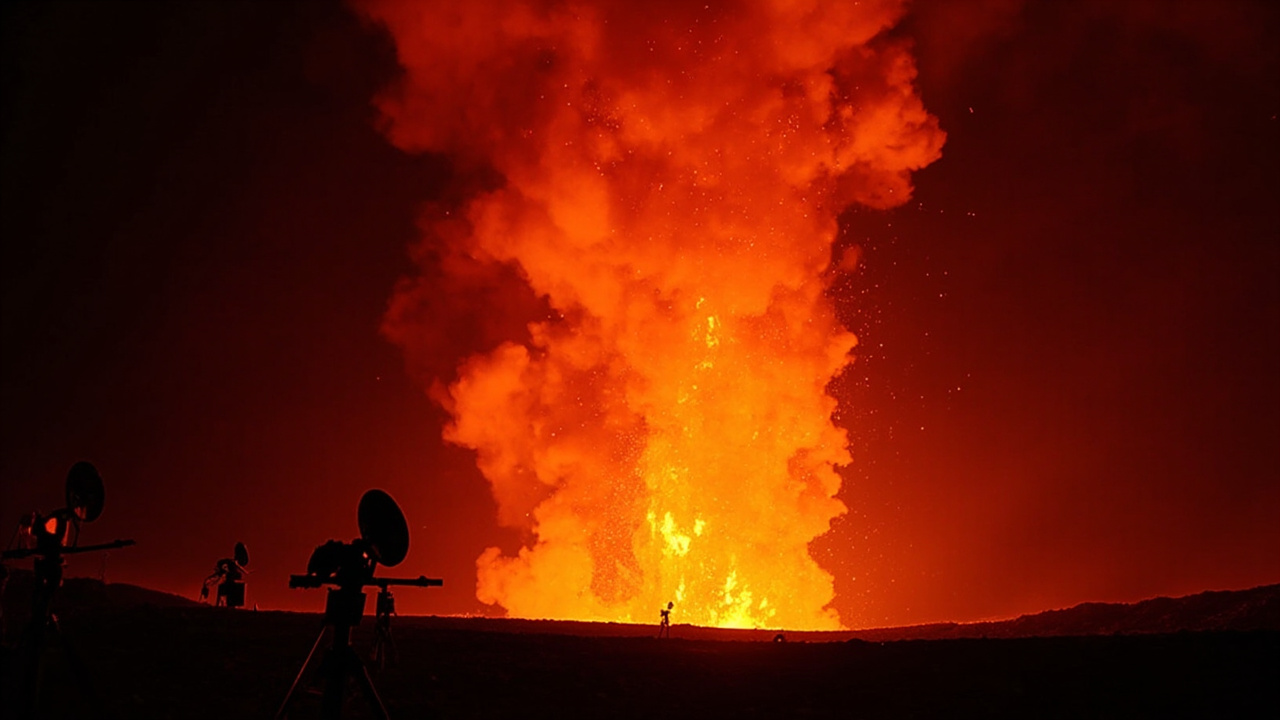
Kīlauea has been intensely studied and monitored by instruments for decades, according to Science News. For the fountain sequence, 35 separate data-gathering stations were set up on Kīlauea, including “seismic, infrasound, geodetic, gas, and visual and thermal cameras,” according to Ars Technica. Scientists continuously collect data on seismic activity, temperature, low-frequency acoustics, ground swelling or deflation, and escaping gases, according to Science News.
In 2024, a large series of earthquakes accompanied the opening of a vent, and a 900-meter-long fissure opened, according to Ars Technica. That opening sent fountains as high as 160 meters into the sky over the course of 13 hours, according to Ars Technica. Less than a day after that subsided, a second eruption followed, according to Ars Technica. As of last month, 52 additional fountain eruptions had occurred, the most violent of which spewed lava over 400 meters into the air, according to Ars Technica.
Other tallies place the maximum higher. Some fountains shot as high as 457 meters into the sky by September 2026, according to Science News. Fountain heights varied over months and reached about 480 meters, according to Science. On April 23, 2026, Kīlauea began its 45th lava fountain episode since the current eruption began in December 2024, according to Science News.
Tephra affected National Park Service infrastructure, roads, and communities as far as about 70 km downwind, according to Science.
Tilt and inflation allowed quantitative forecasts
Perhaps the most significant finding was that researchers could predict when a fountaining eruption was likely to happen, according to Ars Technica. Each eruption caused rapid deflation of the summit of Kīlauea and was followed by relatively slow refilling of the Halemaʻumaʻu magma reservoir, according to Ars Technica.
Pauses were characterized by slower reinflation as pressure rebuilt within the shallow Halemaʻumaʻu magma reservoir, according to Science. Before each fountain, the floor of the bowl-shaped caldera would swell and tilt, suggesting magma was gathering beneath, according to Science News.
The USGS recognized that consecutive eruptions occurred when the summit tilt reached similar levels, according to Ars Technica. Fountaining repeatedly began as summit tilt approached similar but gradually evolving thresholds, according to Science. While the precise tilt associated with eruptions tended downward over time, the difference between consecutive eruptions was relatively small, according to Ars Technica.
Eruption forecasts based on the intersection of the long-term threshold trend with ongoing reinflation provided quantitative estimates of episode onset and supported public hazard communication, according to Science. That pattern ultimately helped the organization issue alerts when eruptions were likely to occur, which was especially useful because there were no clear seismic signals immediately before fountains restarted, according to Ars Technica.
The U.S. Geological Survey publication record likewise states that systematic correlations between fountaining and summit inflation enabled unprecedented quantitative forecasts. Patterns of summit inflation have allowed quantitative forecasting for the onset of each episode, according to Science.
Gas-piston signals appeared before sustained fountaining
As the eruption matured and the fountains continued, a pattern emerged, first appearing before the fourteenth fountain, according to Science News. Just before that eruption, the team detected a repetitive sequence of minutes-long bursts of seismic energy and low-frequency acoustics, according to Science News.
Beginning with episode 14, sustained fountaining was commonly preceded by gas-piston activity, marked by repetitive seismic and infrasonic bursts as magma cyclically rose and fell within the vents, according to Science. Those signals are linked to the buildup and release of trapped gases in magma, which make it rise and fall through narrow volcanic vents in the rock like a piston in a car, according to Science News.
Sulfur dioxide emissions decreased as magma rose and increased during drainback, which is consistent with shallow gas accumulation and release, according to Science. The team also noted that while the volcano released some sulfur dioxide gas, there was relatively little carbon dioxide, according to Science News.
Sulfur dioxide levels rose during eruptions and dropped afterward, but remained high throughout the entire period, according to Ars Technica. Levels of this chemical are associated with gases escaping from magma, so this implies that more release goes on during eruptions, but it also occurs continuously between them, according to Ars Technica.
Two hypotheses were tested against the new measurements
There have been two prevailing ideas about what initiates, sustains and ends episodic fountains, according to Science News. Water dissolved in magma — the underground, molten mix of rock and gas — rising from deep inside the volcano suddenly escapes as pressure changes, leading to a burst of activity, according to Science News. The other idea involves a carbon dioxide–rich foam atop the trapped magma, like the pressurized froth over a shaken bottle of soda, suddenly and violently expanding, according to Science News.
Ars Technica describes the same contrast in physical terms. One leading idea is that pressure within a magma reservoir keeps water mixed with other materials until it reaches a shallow enough depth to exit as steam, according to Ars Technica. That fragments the magma, which allows it to ascend more rapidly, which allows more steam to escape, and so on until there is a jet of material near the surface, according to Ars Technica. The alternative posits that things are driven by release of carbon dioxide from the magma, which forms a magma/gas “foam” at the roof of the magma chamber, according to Ars Technica. Once this reaches a critical point, the gas escapes, driving magma with it until the supply in the magma chamber is exhausted, according to Ars Technica.
The processes that initiate, sustain, and terminate individual episodes remain uncertain, according to Science. Two leading mechanisms proposed in the literature are pressure-driven magma ascent followed by water-rich volatile exsolution in a shallow conduit, and accumulation and collapse of carbon dioxide–rich foam near a magma-reservoir roof, according to Science.
The new data does not provide a clear picture, according to Ars Technica. It clearly does not favor formation of a carbon dioxide foam, because levels of the gas remained low throughout the eruption cycle, according to Ars Technica. This is described as a preliminary glimpse, with many questions remaining, according to Science News.
So the evidence leans toward the steam-driven eruption model, but it is unclear why a process that is occurring throughout the cycle suddenly triggers fountains when it rises a bit, according to Ars Technica.
Hotter magma repeatedly flushed the shallow reservoir
The erupted magma was overall more mafic than summit magma erupted during 2020–2023, according to Science. Cyclic changes in glass magnesium content indicate periodic flushing of the Halemaʻumaʻu reservoir by hotter, more mafic magma, according to Science.
The chemistry points in the same direction in the Ars Technica account. Magnesium oxide provides an indication of the temperature of the magma, according to Ars Technica. It fluctuated throughout the eruption cycle, consistent with a cycle in which eruptions deplete a reservoir, which is then refilled with hot material, according to Ars Technica. In contrast, other oxides rose over time, suggesting that the newly arriving material has a distinct chemical composition, according to Ars Technica.
Sampling of gas levels is typically done at infrared wavelengths and, during a fountaining eruption, there was a large amount of activity in the infrared, according to Ars Technica. Because of the height of some of the fountaining, it was not necessarily safe to install more monitoring hardware, according to Ars Technica. One camera notably sacrificed itself in order to bring images of red-hot, semi-molten rock falling from the sky, according to Ars Technica.
While Kīlauea has proven itself as a spectacular laboratory for studying volcanic activity, it has not yet given up all its secrets, according to Ars Technica. This is the first Kīlauea episodic fountaining sequence observed with a dense, modern monitoring network, according to Science. The eruption will provide new constraints on the timing, evolution, and processes driving episodic fountaining globally, and highlights Kīlauea’s role as a natural laboratory for studying volcanic processes, according to the U.S. Geological Survey publication record.
Sources referenced
- What's been driving Hawaii's lava fountains? - Ars Technica (https://arstechnica.com/science/2026/10/whats-been-driving-hawaiis-lava-fountains/)
- Kilauea's display is revealing why volcanoes spew like a fountain show - Science News (https://www.sciencenews.org/article/kilauea-why-volcanoes-spew-fountains)