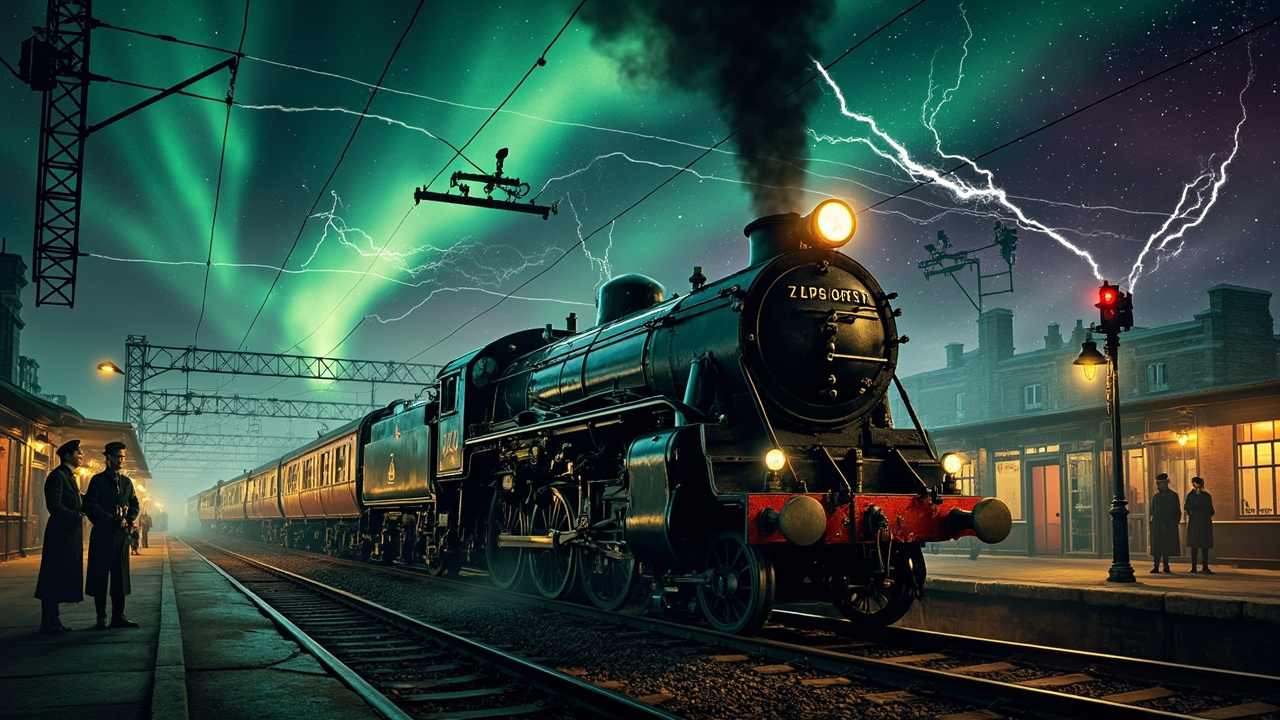
TL;DR: The famous 18 October 1841 space-weather train delay at Exeter never happened in 1841 — new research finds the year was a typo for 18 October 1848.
A team led by Lancaster University space physicist Jim Wild reports that an anonymous 1871 account in Nature of a “very intense magnetic disturbance” delaying a 10:05 p.m. express by 16 minutes could not describe 1841, because the South Devon Railway track between Exeter and Plymouth it referred to did not yet exist, according to Ars Technica.
A 30-year-old memory that did not fit the railway timetable
The anonymous Nature correspondent wrote about three decades after the supposed event that magnetic and auroral storms had made it impossible for a telegraph operator at Exeter to tell whether the line ahead was clear or occupied, according to Ars Technica.
That detail mattered because early railway companies used electrical telegraphs for block signaling to prevent collisions on single sections of track, according to Ars Technica.
Wild and colleagues questioned the account because the author was unnamed, no citation was given, and publication came 30 years after the claimed October 1841 disturbance, according to Ars Technica.
A check of railway history showed Parliament did not approve construction of the Exeter-to-Plymouth line until July 1844, and the relevant section did not open until 30 May 1846, five years after the reported delay, according to Ars Technica.
Physics World reported the same central railway finding in simpler terms: the line in that part of England did not open until 1846, so space weather could not have delayed the 10:05 p.m. departure from Exeter in 1841.
Associate Professor Brett Carter of RMIT University, a co-author, put the point directly in comments reported by The Debrief: the Exeter-to-Starcross line mentioned in the old paper did not exist until 1846, five years afterward, so the 1841 date had to be a typo.
Why researchers still took the story seriously
In 2013, physicist Trey Cade, who leads the Space Weather Research Laboratory at Baylor University, had suggested the Exeter anecdote might be the earliest recorded example of space weather affecting human technology, according to Physics World.
That possibility drew attention because telegraph disturbances during geomagnetic storms had otherwise been traced to the late 1840s, while the infamous Carrington Event of 1859 remained the most powerful geomagnetic storm in the scientific record, according to Ars Technica.
The Carrington storm produced worldwide auroral displays so bright that people reported reading newspapers by their light, with sparking and some fires in telegraph stations, according to Ars Technica.
The telegraph itself was relatively new at that time, having emerged in the 1830s, and a likely coronal mass ejection from the Sun drove geomagnetically induced current that knocked out systems, although some operators transmitted after disconnecting batteries by using auroral current alone, according to Ars Technica.
The Debrief noted the same Carrington effects: energy induced in wires let some systems work without normal power, while other lines overloaded, with reports of fires and shocks to operators.
Against that background, an 1841 railway disruption would have pushed the technological impact of space weather back by several years, which explained why Wild’s group examined whether the correspondent misremembered a later storm, according to Physics World.
Tracking the anonymous Nature correspondent
Wild and colleagues could not locate the original source material behind the 1871 Nature article, but they found the publisher’s copy bearing a handwritten annotation reading “N. [J.] Holmes,” according to Ars Technica.
They concluded the writer was most likely Nathaniel John Holmes, a prominent electrical engineer involved in deploying undersea telegraph cables across parts of the North Sea, according to Ars Technica.
In 1871 Holmes lived in Hampstead, about one mile from where Nature editor Sir Norman Lockyer lived, according to Ars Technica.
Contemporary newspaper accounts showed Holmes lecturing in Scotland on chemical effects of the solar spectrum, indicating interest in solar activity and familiarity with Lockyer’s discovery of helium lines in solar spectra, according to Ars Technica.
An 1877 letter from Holmes inviting Lockyer to visit further indicated a business relationship, according to Ars Technica.
The authors wrote that no citation was supplied that would allow verification, and that the vivid claim that operators “reported next morning that someone was playing tricks with the instruments” suggested a contemporary newspaper origin, although they found no report containing that phrase, according to Ars Technica.
Magnetograms, sunspots and newspapers point to 1848
The team then compared the earliest magnetograms from the Greenwich magnetic observatory in London, historical newspapers, railway timetables, solar observations, aurora reports and digitized geomagnetic records, according to Physics World.
Those Greenwich records include “extraordinary” magnetic-field observations indicating strong storms as far back as 1840, but the researchers found no unusual activity such as aurora reported in England for 18 October 1841, according to Ars Technica.
By contrast, strong geomagnetic activity occurred around 18 October 1848, confirmed in contemporary newspaper accounts and in sunspot observations made by British observers, according to Ars Technica.
The Debrief reported the team’s conclusion the same way: the day and month were probably remembered correctly, but the year was actually 1848, after comparison of newspapers, timetables, solar observations, auroral reports and geomagnetic records.
The published study includes the Greenwich magnetogram recorded from 11:20 UT on 18 October 1848 to 00:20 UT on 19 October 1848 as key evidence for the revised date, according to Ars Technica.
The international group included specialists from Lancaster University, the British Geological Survey, Natural Resources Canada, Nature, RMIT University in Australia and STFC RAL Space in the United Kingdom, as well as Cade, according to Physics World.
The paper, titled “Did Space Weather Delay the 10:05 p.m. Train Departure from Exeter on 18 October 1841?”, appeared in the journal Space Weather on 16 September 2026, according to The Debrief.
What becomes the earliest credible technological impact
With the Exeter date corrected, the authors say the earliest known example of space weather affecting human technology is now an incident involving telegraph systems on England’s Midland Railway in March 1847, according to Physics World.
The Debrief likewise reported that the earliest credible communications interruption by space weather on record occurred in 1847 at Midland Railway once the 1841 date was revised.
Wild said the broader lesson was continuity rather than novelty, stating that society has faced space-weather effects on technology almost as long as electrical technologies have existed, with affected systems evolving from railway telegraphs to satellites while risk and resilience remain central, according to Physics World.
He also said the Exeter delay sits where emerging technologies first encountered the space environment and shows space weather as more than a modern challenge tied to satellites, communications systems and electricity networks, according to Ars Technica.
Carter said understanding the episode matters because the 1840s mark the intersection of the technological age and long-present space weather, adding that humans have not looked back since that line was crossed, according to The Debrief.
RAL Space researcher Mike Hapgood, a co-author, said deeper understanding of such events is essential for preparing for and mitigating impacts, especially looking toward developments facing a new solar cycle in the 2030s, according to The Debrief.
Why old storms help protect modern grids and satellites
Scientists study past disturbances because a Carrington-scale storm today would likely damage power grids, cause widespread outages and blackouts, and disrupt satellite communications, making stronger forecasts important for mitigation, according to Ars Technica.
Modern networks are in some ways more exposed than Victorian wired systems because many links are wireless and many assets operate in space without shielding, while forecasting ability has improved through investigation of past events, according to The Debrief.
University of Oslo space-weather researcher Lasse Clausen, who was not involved in the Exeter study, told Physics World that limited ionosphere data is the largest barrier to understanding, leaving prediction roughly where conventional forecasting was in the 1920s.
Clausen described current capability in plain terms quoted by Physics World: observers can look outward and report present conditions, much like saying whether rain is falling, but forward prediction remains limited.
He said additional funding will be needed and that awareness is essential because the ionosphere is useful but not widely viewed as exciting, calling the Exeter investigation a nice piece of detective work that belongs in awareness-raising, according to Physics World.
Wild concluded that, although the Exeter case is no longer the earliest recorded impact, it remains one of the first clear examples of solar activity disrupting critical infrastructure and shows the value of combining scientific records with newspapers and archival documents, according to The Debrief.
Sources referenced
- Scientists solve 1840s space weather mystery - Ars Technica (https://arstechnica.com/science/2026/09/scientists-solve-1840s-space-weather-mystery/)
- Did space weather delay a train in 1841? – Physics World (https://physicsworld.com/a/did-space-weather-delay-a-train-in-1841/)