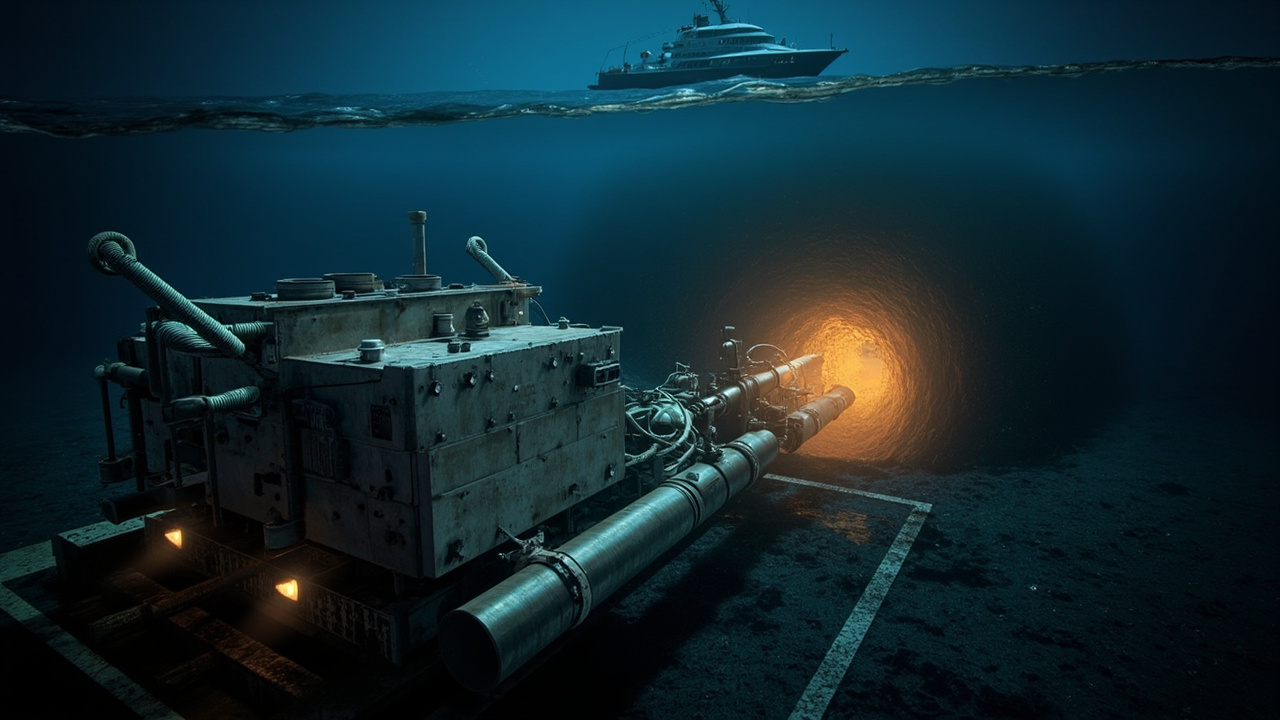
TL;DR: Seattle startup Endurance Energy generated net-positive electricity from heat at an active Pacific underwater volcano on Sept. 27, 2026, during a three-week test at Axial Seamount.
On Oct. 19, 2026, Endurance Energy announced what it described as the first end-to-end demonstration of subsea geothermal power, according to the Endurance Energy press release. The company's Adélie test system produced more electricity than it consumed while sitting on Axial Seamount, an active submarine volcano about 300 miles off the Oregon coast. The net-positive interval lasted 8.7 seconds, with a median output of about 2 kilowatts net and a peak of 16.5 kilowatts net.
The deployment took place in September 2026 over about three weeks at a depth of about 5,000 feet, or nearly a mile beneath the Pacific Ocean surface, according to the Endurance Energy press release. Endurance positioned equipment inside the Axial Caldera and then drilled, installed, operated and monitored a seafloor power system. The company said the test combined drilling a well, landing and operating a power plant, converting geothermal heat into electricity and communicating with the system from shore in real time.
A first well beneath the seafloor
Endurance said its subsea lander drill bored two holes less than two feet apart in the Axial Caldera, and both encountered hydrothermal fluid, according to the Endurance Energy press release. The crew cased and cemented the second hole, capped it with a valve and completed a 52-foot geothermal well equal to 16 meters. After cementing, the company reported flow at 260 degrees Celsius, or 500 degrees Fahrenheit.
The well measured approximately two inches wide, according to the Endurance Energy press release. By comparison, the company said oil, gas and onshore geothermal wells often start with casings 20 to 36 inches across. The narrow bore marked a sharp departure from conventional geothermal drilling dimensions.
The project used a modified geotechnical drill of the type offshore developers normally use to recover core samples of subsea rock, according to Canary Media. The team worked from the research vessel Ocean Guardian and drilled into a vent field at the base of the volcano, where hot mineral-rich seawater was present. Canary Media reported that the September operation sailed about 300 miles west of Oregon to Axial Seamount along the Juan de Fuca Ridge.
IEEE Spectrum reported that Endurance surveyed the seismically and volcanically active Juan de Fuca Ridge by remote sensing before selecting flat areas near Axial Seamount, described as the region's largest and most active volcano about 500 kilometers from Oregon. The same account said the company drilled a shallow 16-meter well to reach briny hydrothermal fluid at around 250 degrees Celsius. Endurance founder and CEO Andrew Redd told that publication the temperature range of 250 to 350 degrees Celsius represented a sweet spot that would let the team use mostly normal terrestrial materials.
Why the power run used a natural vent
The newly drilled well delivered hot fluid but proved too restrictive to operate the power plant, according to the Endurance Energy press release. The team therefore connected Adélie to a nearby natural hydrothermal vent for the generation attempt. That vent flowed at approximately 281 degrees Celsius, or 538 degrees Fahrenheit.
Adélie is a 3-ton seafloor power system, according to the Endurance Energy press release. It uses an organic Rankine cycle system, the same general approach used in many land-based geothermal projects, to transfer heat from hydrothermal fluid and spin a turbine, according to Canary Media. The undersea unit contains closed-loop heat-transfer equipment designed to generate electricity from that heat.
During the Sept. 27 run, Adélie's turbine reached approximately 26,000 revolutions per minute, according to the Endurance Energy press release. OilPrice.com reported the same turbine speed and the same median and peak net outputs during the successful generation test. For 8.7 seconds, the system made more electricity than it consumed.
Canary Media reported a broader generation window of about 29 seconds that produced about 60 watt-hours, with nearly nine seconds in net-positive operation and surplus electricity charging the battery backup system. The company moved the unit to the natural vent after determining that the drilled well could not supply Adélie, according to that account. Fast Company similarly reported that the full process did not work exactly as planned, but the generator briefly produced power when linked to a natural opening in the seafloor.
How the dive ended
Endurance said battery overcurrent protection stopped the net-positive run at the natural vent, according to the Endurance Energy press release. About 10 minutes later, during a restart attempt, a power cable feeding Adélie's refrigerant pump failed and ended the dive. OilPrice.com gave the same sequence of an electrical protection interruption followed by a cable failure during an attempted restart.
Canary Media reported that the run ended after the battery's overcurrent protection activated and that a power cable failed soon afterward. Redd described the outing as a first end-to-end demonstration of the subsea geothermal concept and said the team learned a large amount from each stage, according to Canary Media. The company characterized Adélie as a test article rather than a commercial-scale power plant, intended to reveal engineering realities of deep-ocean geothermal operation, according to the Endurance Energy press release.
Data collected during the deployment covered seafloor drilling, well flow, heat transfer, mineral buildup, high-temperature power generation and long-distance control of subsea equipment, according to the Endurance Energy press release. Endurance said it will use that information to design its next system. Fast Company reported that the experiment stopped when a power cable failed, after operation in conditions that included 10-foot waves at the surface while the 3-ton generator was lowered.
Operated from Seattle over seafloor fiber
Endurance landed Adélie on target and commanded the plant in real time from Seattle, according to the Endurance Energy press release. The link used the National Science Foundation's Regional Cabled Array, a seafloor fiber-optic network operated by the University of Washington as part of the Ocean Observatories Initiative. The team also tested optical and acoustic communications links and ran high-temperature hydrothermal fluid through the plant.
Canary Media reported that a crew in Seattle received real-time temperature and flow-rate data and operated the plant remotely through an existing fiber-optic cable network. IEEE Spectrum reported that temperature and flow-rate data from Adélie would travel back to shore in real time through the National Science Foundation's Ocean Observatories Initiative cable network, one reason Endurance selected the site. That publication described the Juan de Fuca Ridge as an extremely well-researched and well-surveyed section of ocean floor.
The company was founded in January 2025 and made its first deep-sea deployment in August 2025, according to the Endurance Energy press release. Adélie was its fifth deep-sea deployment in just over a year and its first to test drilling, installation, generation and shore communication together. Canary Media likewise identified Adélie as the company's fifth deep-sea deployment and the first to combine all of those steps.
Environmental monitoring at the vent field
Endurance said it drilled away from hydrothermal vent chimneys and surrounding marine life, according to the Endurance Energy press release. The team used filtered seawater rather than drilling mud, avoiding chemicals commonly used in offshore oil and gas drilling. Before placing equipment, the company said it mapped the seafloor and chose the least disruptive site.
The company ran a voluntary environmental monitoring program throughout the deployment, according to the Endurance Energy press release. It sampled water before and after every operation and recorded the surrounding seafloor community on video during every dive, including tubeworms, snails, crabs and bacterial mats. More than 40 water, rock and mineral samples are now with independent laboratories for analysis.
The team compared its findings with 11 instruments operated by outside scientists, according to the Endurance Energy press release. The loudest recorded sound was the ship's engine, within the normal range for research vessels at Axial Seamount based on three years of recorded data. No marine mammals were observed. The company reported no unusual seismic or volcanic activity, no significant changes to the seafloor community and no significant change to natural hydrothermal activity at the site.
IEEE Spectrum reported that Endurance took baseline temperature and environmental measurements before the deployment so it could later evaluate effects on the surrounding ecosystem. Redd told that publication the team was focused on learning as much as possible while acting as a careful steward of the vent systems.
Startup history and commercial plans
Redd, a former SpaceX engineer, launched Endurance in January 2025 to develop a continuous energy source, according to Canary Media. The Seattle-based company has raised $63 million from venture capital firms, according to Canary Media. Fast Company also reported $63 million raised and said the company launched at the beginning of 2025 and completed five undersea deployments before the September end-to-end test.
Endurance is partnering with the Kingdom of Tonga on a proposed 2-megawatt project intended to reduce the island nation's reliance on imported diesel, according to Canary Media. IEEE Spectrum reported that Endurance aimed to operate on Axial Seamount for a year and planned to deploy a 2-megawatt unit off Tonga by the end of 2027. Unlike the Oregon pilot, the Tonga system would generate power for the island and would not be placed as close to active volcanoes where seismic activity posed a risk.
For the next step, Endurance said it will deploy Gentoo this winter, a refurbished and upgraded version of Adélie intended for higher power and longer sustained generation, according to the Endurance Energy press release. While the Adélie well reached 16 meters, the company said its current lander drill can reach 80 meters, or about 260 feet. The company expects deeper wells to deliver greater performance.
Redd said, “On Sept. 27, we put a power plant on an active underwater volcano and made power,” according to the Endurance Energy press release. He also said, “Adélie did,” in response to the question of whether the system could generate more power than it uses, according to the same release.
Why outside researchers remain cautious
Emily Pope, a geologist and senior fellow at the Center for Climate and Energy Solutions, called the approach “eyebrow-raising,” according to Canary Media. She said offshore geothermal was scientifically intriguing but difficult to justify economically because of harsh, salty ocean conditions and the distance power must travel to customers. She added that remote island nations could more easily use lower-cost solar power and batteries.
Roland Horne, director of Stanford's geothermal program, told IEEE Spectrum that subsea geothermal was “a slightly dingbat idea, at least for grid generation,” while seeing potential in certain uses such as power for islands. He remained skeptical because companies had long tried without making offshore geothermal work at scale, and logistics plus performance in harsh deep-ocean conditions remained open questions.
Earlier offshore geothermal work focused mainly on research rather than commercial power, according to Canary Media. In 2016, Chinese scientists produced a few watts of sustained power from a hydrothermal vent where the southwest Indian Ocean meets the southeast Atlantic Ocean. In southwest Iceland, a government-backed project drilled a geothermal well near the Mid-Atlantic Ridge, but corrosive seawater created major engineering problems.
Redd said Endurance was designing technology “from scratch” to survive deep-sea pressure and corrosiveness, including extensive use of titanium, according to Canary Media. Fast Company quoted Redd saying no one had previously attempted the effort at anything close to the commercial scale Endurance was pursuing. The company said commercial subsea geothermal systems would convert heat beneath the ocean floor into continuous, weather-independent electricity for coastal grids and industrial sites around the Pacific and worldwide, according to the Endurance Energy press release.
Sources referenced
- Endurance Energy Drills World’s First Subsea Geothermal Well and Runs First Net-Positive Power Plant (https://www.enduranceenergy.com/press/adelie)
- This geothermal startup produced a tiny bit of power from the seafloor | Canary Media (https://www.canarymedia.com/articles/geothermal/geothermal-startup-power-seafloor-drilling)