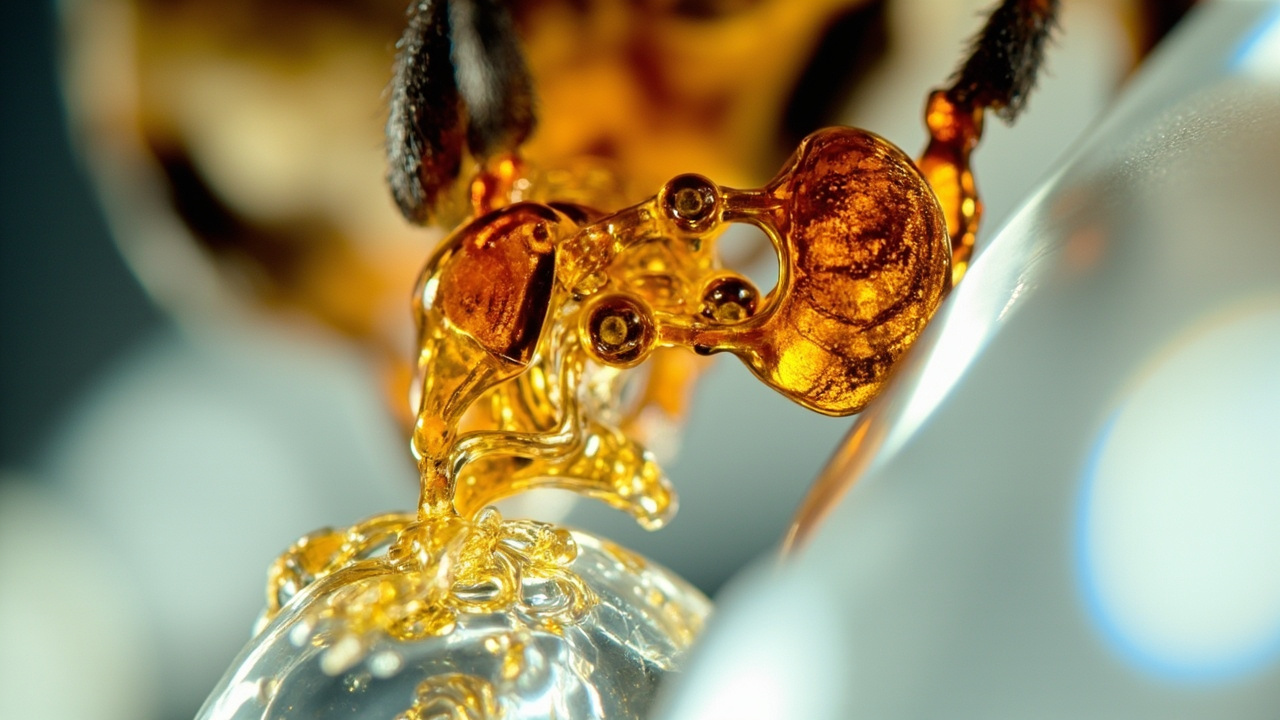
TL;DR: A 2-millimetre honeybee stinger keeps injecting venom after detachment by using two shape-shifting valves that act as opposing collapsible pistons.
Honeybees leave behind more than a sharp tip when they sting and depart. The separated stinger drives itself deeper and meters venom without input from the insect, and researchers have now watched that independent pumping cycle directly.
A study published Oct. 12, 2026, in the Proceedings of the National Academy of Sciences describes the apparatus in the Western honeybee, Apis mellifera, as a sophisticated double-piston micropump, according to EurekAlert!. The paper is titled “The honey bee stinger: An unusual pump with collapsible double pistons” and carries DOI 10.1073/pnas.2603916123. Lead author Fiorella Ramirez-Esquivel of Macquarie University worked with colleagues from Macquarie and the University of New South Wales. Reporting by Ars Technica on Oct. 13, 2026, summarized the central result as a pump-like mechanism with two valves moving in opposition.
That result resolves a question dating to 1910. Researchers had long known that venom from the sac enters a chamber containing small pumping elements termed valves, but they had not established how those elements generated flow.
What the detached stinger does alone
Worker honeybees push the stinger into a target, then depart and abandon the structure, a separation termed autotomy. The abandoned unit subsequently advances into tissue and discharges venom using its own muscles, nerves and mechanical parts.
The new work shows continuity rather than a single squeeze. Because the two internal valves operate out of phase, one can pressurize fluid while the other resets, producing sustained delivery instead of intermittent pulses. According to EurekAlert!, the authors describe continuous flow from a compact, self-contained unit as the functional payoff of the paired design. Ars Technica likewise reports that the paired motion limits reverse flow during refilling.
The scale is striking. The entire stinger measures about 2 millimetres, or 0.08 inch, yet contains a venom sac, a pumping chamber, muscles, nerves and paired piercing elements.
How high-speed video captured the cycle
The team collected live worker bees and separated stingers with forceps immediately before recording, according to Ars Technica. Researchers partly seated each stinger in a block of transparent gel formulated to stand in for human skin.
They then recorded activity with stereomicroscopy and high-speed color video. Transmitted illumination through the semi-translucent structures made internal motion visible, and frame-by-frame review allowed tracking of rapid deformations that would blur at ordinary frame rates.
One released clip, recorded at 300 frames per second from the side, shows a detached stinger edging farther into the gel substitute through alternating lancet motion, according to EurekAlert!. Because the gel does not absorb or wick fluid the way living tissue might, expelled venom becomes visible as it is forced back toward the surface.
The approach mattered because detachment permits an unobstructed view. In a living bee, surrounding tissue and body movements would complicate observation of the chamber interior. The gel target provided both a realistic penetration task and optical access.
Anatomy of a 2-millimetre pump
The stinger contains three principal interlocked parts that define the venom passage: a central stylet that broadens into the main chamber and two sharp-tipped lancets that travel back and forth, according to Ars Technica.
The lancets perform two jobs. Their reciprocating travel helps bore into skin, much like the action of a reciprocating saw, and their attached valves drive fluid. The rails that guide the lancets are called the olistheter, according to EurekAlert!.
The pumping chamber, sometimes described as the bulb chamber, receives venom from the sac through an inlet. An outlet at the lower end routes venom toward tissue. Each lancet carries a valve positioned inside that chamber.
During operation, the valves do not behave as rigid plungers. They expand, seal, collapse and slide past one another in a repeating sequence that maintains pressure while allowing refill.
Parachutes, umbrellas and passing in the middle
On the power portion of the stroke, each valve flares outward and spans the chamber cross-section. Coverage from Ars Technica describes inflation resembling a parachute, producing a piston-like seal that presses downward on chamber fluid and expels venom through the outlet.
On the return, the same structure folds down and narrows. That collapsed profile reduces resistance as the valve travels back toward the top of the chamber. The shape change also curbs backflow while fresh venom enters for the next power stroke.
The most unexpected moment occurs mid-cycle. Since the two valves travel in opposite directions inside one cylinder, they must cross paths without losing the seal that makes pumping effective. Video showed the valves deforming again as they met so they could slip past each other, according to EurekAlert!.
Ramirez-Esquivel said the geometry makes that crossing possible and lets opposite-direction pumping sustain flow, according to Ars Technica. In one quoted explanation, she said, “The unique geometry of the valves is the key; they act as collapsible pistons.” In a related statement carried by EurekAlert!, she added that the paired arrangement adds complexity but enables continuous delivery in a compact autonomous package.
The authors also linked the valve action to preliminary flow-visualization tests. Those early checks were consistent with the kinematics seen in high-speed footage, according to Ars Technica.
A 3D-printed scale model tested the idea
Imaging alone could not fully settle how form produces flow because the parts are minute, curved and difficult to inspect from every angle. The researchers therefore scanned stingers with micro-computed tomography and built an enlarged physical replica.
The replica reproduced the bulb chamber and lancets at a scale large enough to observe and manipulate. Different plastics were evaluated, and rigid plus flexible materials were combined to approximate the chamber and valve behavior, according to reporting associated with the study.
The enlarged model was then actuated and filmed. Its pumping pattern matched the biological stingers when analyzed frame by frame, supporting the interpretation developed from live-stinger video, according to Ars Technica. EurekAlert! similarly reports that the printed working model, described as a small robot, confirmed central features of the cycle.
The exercise also highlighted material demands. Ars Technica reports that the team’s artificial polymer valve indicated very high elasticity is important for achieving the required folding and sealing, alongside low friction between the contacting valves.
Why bees differ from spiders, snakes and wasps
Venom systems vary widely across animals. Spiders use muscles around venom glands that contract and eject fluid through hollow fangs. Snakes likewise compress reservoirs with surrounding musculature. Bees, wasps and ants use stingers, powered either by muscles around a reservoir or by coordinated stiff lancets.
Honeybees add detachment. Few venomous animals abandon the delivery device and rely on it to finish the task independently. The new findings give that autonomy a mechanical basis: muscles and nerves remain with the discarded stinger, while the collapsible-piston valves convert stored energy and chamber refill into continued output.
The study does not claim that muscle squeezing is absent. Rather, it identifies the valve-piston interaction as the previously unseen mechanism that organizes flow into a sustained stream after the bee has gone.
Open questions and possible engineered uses
Several details remain for later work. The team pointed to closer study of valve material properties as a next step, according to Ars Technica. Another unresolved issue is capillary behavior at such small dimensions.
Capillary forces could assist by pulling venom into the narrow canal, or they could oppose delivery if tissue fluid is drawn upward into the device. The authors said that balance needs investigation because the pumping elements are small enough for surface effects to matter.
Engineering interest centers on miniaturization and autonomy. Earlier studies had already used bee-stinger architecture as inspiration for microneedles, tissue-transport tools and drilling concepts. The authors suggest the newly clarified double-piston principle could inform artificial micropumps, microfluidic circuits and minimally invasive medical devices, according to EurekAlert! and Ars Technica.
Such applications remain proposals, not demonstrated products. The published result is the biological mechanism itself: first direct video of opposing collapsible valves sealing, pumping, folding and passing inside a detached honeybee stinger.
Sources referenced
- High-speed video reveals how honey bee stingers pump venom - Ars Technica (https://arstechnica.com/science/2026/10/honey-bee-stingers-are-double-piston-venom-pumps/)
- Ouch! The stinger of a honey bee is revealed as a tiny autonomous double-piston venom pump | EurekAlert! (https://www.eurekalert.org/news-releases/1147051)