TL;DR: Anthropic opened a research preview of the Model Hardware Standard, a shared specification that lets AI agents operate lab and factory equipment.
Anthropic on Thursday rolled out a research preview of its Model Hardware Standard, a framework that allows AI agents to direct physical devices used in scientific research and advanced manufacturing, according to Reuters. The announcement positions the Claude developer as a provider of connecting software for laboratories and factories, rather than only chatbots and models.
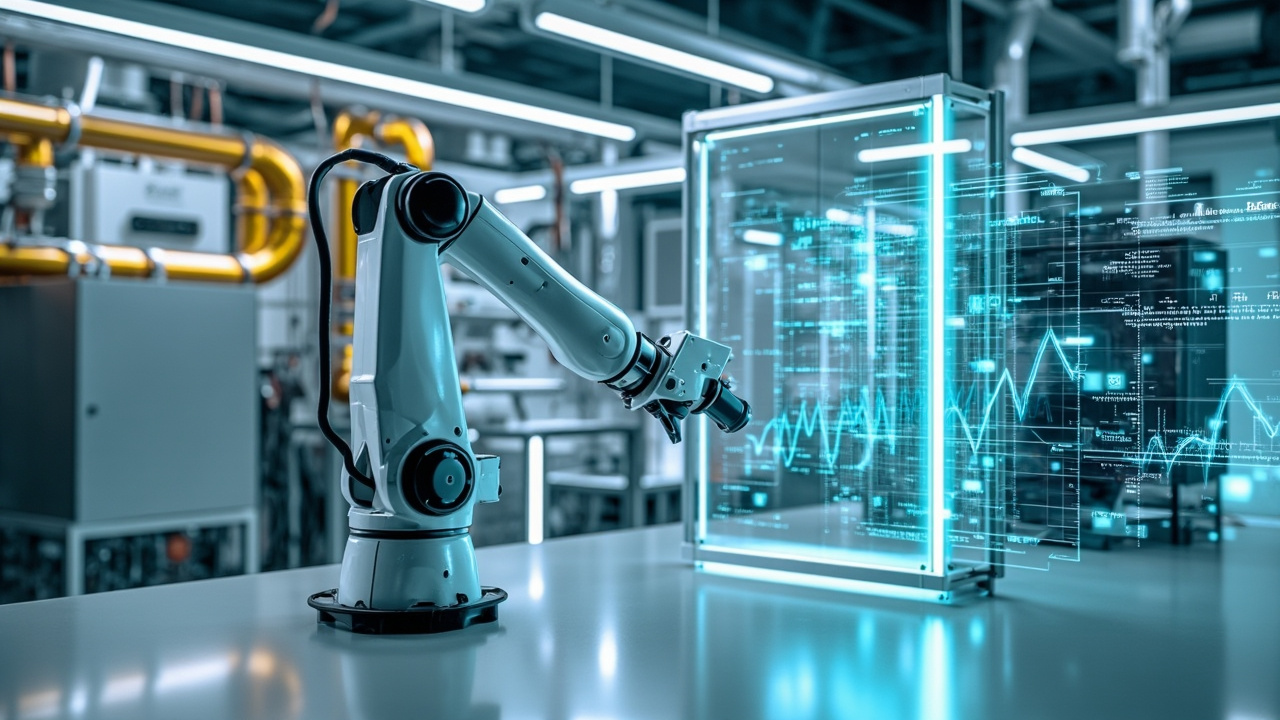
The Model Hardware Standard, or MHS, lets agents run several instruments together, according to Reuters. Examples cited by Anthropic include microscopes, liquid handlers and robotic arms working in parallel. The company said the same approach can support intricate jobs that range from routine drug-discovery experiments to laser calibration on a quantum computer.
The initial release is not a general product launch. Anthropic said it is offering an early version to a first group of scientific research labs and advanced manufacturers, according to its announcement titled Previewing the Model Hardware Standard. Reuters reported that the company is sharing that version with partners to help develop safety evaluations before making the specification open source. CNBC reported that the preview is limited to selected organizations in science, robotics and manufacturing, with a plan to open-source the standard later so any device maker could adopt it.
What Anthropic announced
The core announcement is a shared specification for safe operation of physical equipment by AI agents, according to Anthropic. The company framed MHS as a common layer that sits between agents and machines that already have a programmable interface.
Anthropic said development of MHS began as a collaboration between Anthropic and HHMI Janelia Research Campus. The company said it is now extending access to partners across science, robotics, electronics and manufacturing.
The intent, according to Reuters, is to combine agentic AI capabilities with laboratory and manufacturing hardware so researchers and engineers can run autonomous, round-the-clock workflows with minimal human intervention and speed up processes. Anthropic said agents can reason through each stage of an experiment, update parameters in real time and, in some cases, recover from hardware errors without intervention.
In an interview reported by CNBC, Elizabeth Kelly, head of beneficial deployments at Anthropic, said the work was built for science to demonstrate the promise of AI, while also offering large benefits for enterprise and industry. CNBC described the concept as comparable to a USB-C cord, in the sense that it standardizes how information moves between devices.
Why setup time matters
A major claim behind the release concerns integration time. Anthropic said a laboratory or manufacturing facility typically needs weeks, if not months, to set up and integrate hardware. Most devices do not communicate with each other, the company said, so specialists must build custom integrations for each deployment.
MHS is intended to reduce that integration work to hours or minutes, according to Anthropic. The company attributed the delay in current practice to incompatible programming interfaces and the absence of a standardized way to bring instruments together.
Once devices are connected, Anthropic said, there has also been no common method for them to share data with an AI agent or for the agent to operate them safely. The new specification is meant to address both the device-to-device connection problem and the device-to-agent control problem.
CNBC reported that Anthropic aims to help companies cut the time required to set up and integrate hardware. That objective connects the research preview to commercial use in laboratories and factories, although Anthropic described the present step as a preview for evaluation and best-practice development rather than broad availability.
How the driver works
At the center of MHS is a standardized driver, described by Anthropic as software that translates between a computer operating system and a hardware device. The driver uses a small set of primitives, such as read and write commands. Anthropic gave the examples of get temperature and set temperature as the kind of instruction any compatible device could understand and execute.
The driver also makes each device discoverable in a standard format, according to Anthropic. That discovery function is supposed to let devices and agents find each other and communicate across networks without a bespoke translator program in between.
Another function is context for unfamiliar hardware. Anthropic said the driver helps an agent understand how to use a device it has not seen before by carrying machine characteristics that may not be clear from code alone. The company cited the weight of a robot arm as an example of information important for safe manipulation.
Much of that information has historically lived in paper manuals, on a user computer or as tacit knowledge, according to Anthropic. MHS instead provides tags where a user can write the information in natural language. Users can enter it directly or by chatting with an agent that interviews them about their hardware setup, the company said.
From description to control
From those tags, the driver automatically produces a reference file describing general characteristics of a device, according to Anthropic. That file covers what the device can measure, what can be adjusted and what safety limits will be enforced. The agent then uses that file as its operating guide.
For control, Anthropic listed three mechanisms: MCP, the command line interface and code files, also described as APIs. The company said the three work together to support orchestration across multiple devices through a single line of code.
Once control is established, the agent can receive operating data from each instrument and supervise work at a high level, according to Anthropic. That includes sequencing steps across instruments, monitoring results and adjusting parameters as conditions change in real time.
For longer or faster operations, the agent can chain driver commands from one or more devices into code files, Anthropic said. That lets the devices carry out operations themselves without requiring the agent to reason at every step. The company said this approach is useful when a task must run for a long period or operate faster than online reasoning would allow.
A laser-alignment example
Anthropic described internal testing in which Claude interacted with experiments and hardware in an exploratory manner similar to a scientist. In one example, Claude adjusted a laser, observed the result through a camera to assess how the adjustment moved the beam and repeated the process to understand the sequence of events.
Claude then packaged what it learned into code files, according to Anthropic. It wrote a deterministic script that could align the laser without reasoning at each step, allowing the full process to run as a single command.
The company presented the case as an illustration of moving from exploration to repeatable automation. The agent first investigated the behavior of the equipment, then converted the successful approach into code that the hardware could execute directly.
Anthropic said early work with a small number of labs and hardware manufacturers in biotech, robotics, quantum computing and other fields reduced device-integration time, supported faster iteration in experimental settings and assisted with live operation of machines and real-time fault detection.
Open standard plan and competitive context
An important technical point is that MHS is model-agnostic, according to Anthropic. Any agent harness can access it using standard protocols, such as the Model Context Protocol. CNBC likewise reported that users are not limited to Anthropic's Claude family of models.
That openness links the project to Anthropic's earlier Model Context Protocol, which the company open-sourced in 2024 to make it easier to connect AI agents and data sources, according to CNBC. For MHS, Anthropic said the next step after the research preview is to collaborate on safety evaluations and best practices for AI systems operating physical equipment before making the standard open source.
CNBC placed the announcement in a wider hardware push. It reported that rivals including OpenAI and Amazon have spent billions of dollars designing AI-native devices and manufacturing tools, while Anthropic is building a silicon team to design custom chips for its models. CNBC also reported, citing LinkedIn, that Anthropic recently hired hardware executive Caitlin Kalinowski, who previously worked at OpenAI, Meta and Apple.
For now, access remains limited. Anthropic directed interested labs and manufacturers to apply for the research preview through its project site, while Reuters noted reporting by Deborah Sophia in Bengaluru with editing by Joyjeet Das.
Sources referenced
- Anthropic unveils new framework allowing AI agents to operate physical devices | Reuters (https://www.reuters.com/technology/anthropic-unveils-new-framework-allowing-ai-agents-operate-physical-devices-2026-08-27/)
- Previewing the Model Hardware Standard \ Anthropic (https://www.anthropic.com/news/model-hardware-standard-research-preview)