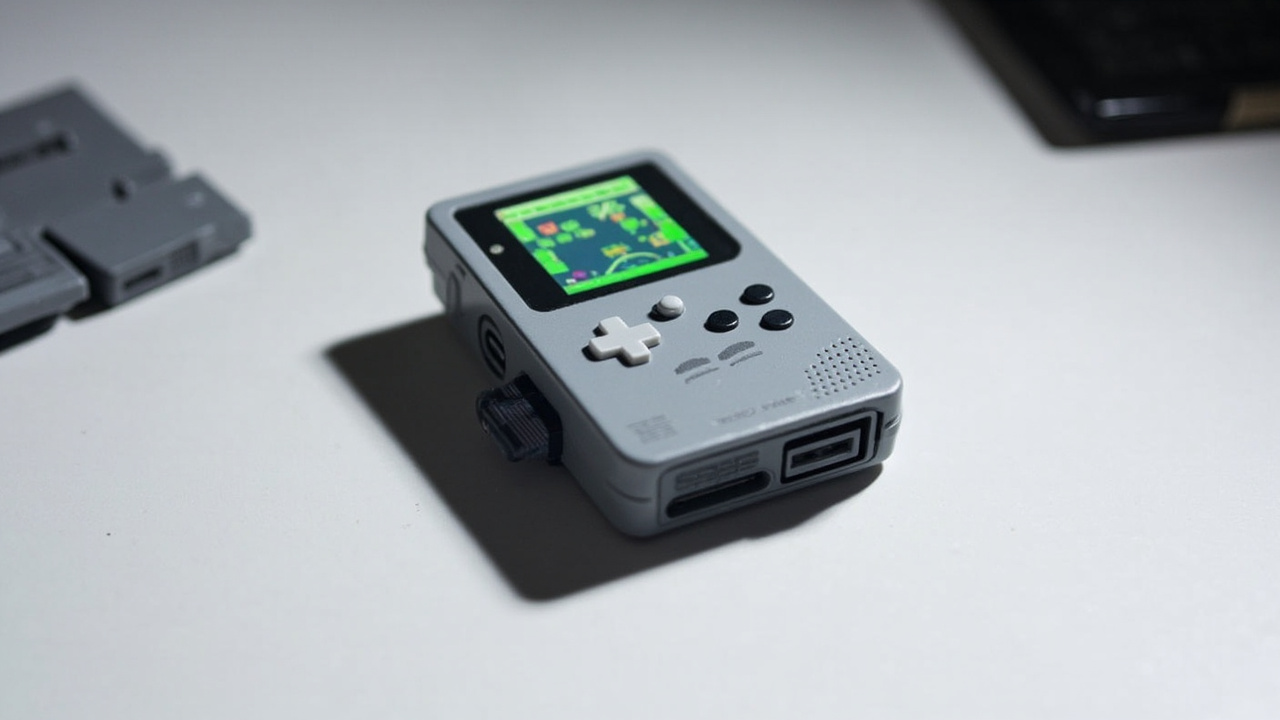
TL;DR: FunnyPlaying's FPGB Mini is a $69.99 FPGA handheld that plays original Game Boy and Game Boy Color cartridges in a body barely wider than a cartridge, and its 20-unit first batch sold out in 10 minutes on Sept. 18, 2026.
A cartridge handheld built for a pocket, not a bag
FunnyPlaying, a Chinese company known for Game Boy and Game Boy Advance upgrade kits, has announced a new handheld that plays original Nintendo cartridges and stored ROM files, according to The Verge.
The device is called the FPGB Mini. Its cartridge support covers Game Boy and Game Boy Color titles, so it is narrower in compatibility than the Analogue Pocket, which also accepts Game Boy Advance and Sega Game Gear games, according to The Verge.
What distinguishes the FPGB Mini is physical scale. The handheld is only slightly wider than the original Nintendo cartridges it accepts, making it unusually easy to carry, according to The Verge. That proportion has become the central selling point in early coverage, alongside a much lower price than Analogue's flagship.
FunnyPlaying listed the pocket-sized device on its official website for an early price of $69, with an eventual retail price of $89, according to PC-Tablet. The Verge described the same offer as a discount from $89.99 to $69.99 for the first batch.
That first batch contained just 20 units, and those units sold out quickly. PC-Tablet reported that the first 20 units sold out within 10 minutes of going live, while The Verge likewise reported that the 20-unit first allocation quickly sold out.
Retro Dodo, which received a review sample before launch, reported that it had been testing the handheld for a few days and found its design and capabilities impressive, according to The Verge's summary of that testing. The broader launch therefore arrived with independent hands-on attention already underway, rather than as an unseen product page.
How the price compares with Analogue Pocket
The FPGB Mini enters a market where the best-known FPGA-based portable has become more expensive. Following recent price increases, the Analogue Pocket is now $239.99, according to The Verge.
Against that figure, the FPGB Mini's $69.99 early price represents a saving of about $170 for buyers who do not need Game Boy Advance or Game Gear support. The standard price is listed at $89 or $89.99 in the two launch reports, still substantially below the Pocket, according to The Verge and PC-Tablet.
FunnyPlaying built its reputation selling aftermarket IPS screen kits, custom shells, and circuit boards to retro-gaming enthusiasts, according to PC-Tablet. Retro Dodo similarly described FunnyPlaying as a retailer focused on modifications for retro consoles, with prior handheld work including the Retro Pixel based around a GAME BOY Pocket-style shell.
The FPGB Mini is therefore not positioned as a direct replacement for the Pocket. It is a smaller, lower-priced alternative limited to 8-bit Game Boy and Game Boy Color software, according to The Verge. It does not support 32-bit Game Boy Advance titles, according to PC-Tablet.
For collectors who mainly own monochrome Game Boy releases, Game Boy Color releases, and imported cartridges such as Japanese versions, that narrower focus may be sufficient. PC-Tablet reported that the console accepts original monochrome releases, Color games, and foreign imports through a rear 32-pin slot.
FPGA hardware, not conventional emulation
Like the Pocket, the FPGB Mini uses field-programmable gate array technology to reproduce Game Boy and Game Boy Color behavior with accuracy comparable to Nintendo's original hardware, according to The Verge.
PC-Tablet explained the distinction by contrasting FPGA hardware logic with inexpensive emulator handhelds that run games through software layers on Linux or Android. In an FPGA implementation, the chip recreates the circuitry of the original console at the hardware level, a design intended to provide accurate game speed, low input delay, and accurate audio playback, according to PC-Tablet.
Retro Dodo published detailed specifications supplied by FunnyPlaying before its sample arrived. Those specifications list a 2.98-inch IPS TFT display with 800 by 720 resolution, RGB565 color handling, and 16.7 million colors, alongside an 1,800mAh removable lithium-polymer battery, according to Retro Dodo.
The same specification set lists USB Type-C charging with support for Power Delivery and other protocols, with actual charging at 5 volts and 1 amp and a full charge requiring approximately two to three hours, according to Retro Dodo. PC-Tablet reported a similar charging arrangement, stating that charging takes around 2.5 hours to fill the internal 1,800mAh lithium battery.
Battery life is estimated at approximately four to six hours, according to both Retro Dodo and PC-Tablet. PC-Tablet specified that the estimate covers operation on a single USB-C charge.
Other listed hardware includes a 0.5-watt front-facing speaker, a MicroSD slot supporting cards up to 32GB formatted as FAT32, and an original 32-pin Game Boy and Game Boy Color cartridge slot, according to Retro Dodo and PC-Tablet.
Size, weight, display and storage
FunnyPlaying gives the shell dimensions as 113 by 64 by 22 millimeters, with weight of about 135 grams including the battery, according to PC-Tablet and Retro Dodo.
That makes the unit substantially smaller than a historic Game Boy DMG while retaining a DMG-inspired appearance. Retro Dodo described the FPGB Mini as designed to look like a shrunken GAME BOY DMG, with Game Boy and Game Boy Color cartridge playback plus ROM-file playback.
The screen is a major part of the appeal in early testing. The 2.98-inch HD IPS panel offers 800 by 720 pixels, a sharp image that scales classic square-aspect Game Boy titles cleanly, according to PC-Tablet. Retro Dodo noted that the relatively high resolution could allow four-times upscaling of Game Boy Color games.
The display supports 16.7 million colors, according to PC-Tablet and Retro Dodo. The Verge likewise identified the panel as a 2.98-inch, 800 by 720-pixel LCD.
Storage and game preservation are handled through MicroSD. The slot supports cards up to 32GB for running digital ROM files and firmware updates, according to PC-Tablet. Retro Dodo added that cartridges save games normally, while ROM files save to the SD card.
Retro Dodo also listed planned MicroSD uses including save backups, screenshots, and future updates. The Verge similarly reported that the MicroSD slot can store game saves, screenshots, or ROMs playable through emulation.
Cartridges, link play, clock and present limits
Users insert original 32-pin cartridges into the rear slot, according to PC-Tablet. The Verge reported the same basic operation: physical Game Boy and Game Boy Color cartridges slide into the handheld for FPGA-based playback.
Multiplayer remains possible despite the miniature size. The handheld allows multiplayer and trading over a USB-C cable, according to The Verge. PC-Tablet reported that FunnyPlaying wired the USB-C port to support classic link-cable gaming through separate adapters, allowing activities such as trading Pokémon or playing multiplayer matches.
Retro Dodo provided a more specific compatibility warning, reporting that link-cable compatibility requires FunnyPlaying's own USB-C proprietary link cable, to be purchased separately. Availability and pricing for that cable remained unknown at the time of Retro Dodo's Sept. 17 specifications report.
A built-in real-time clock supports games that depend on time. PC-Tablet reported an integrated CR2032 coin battery that keeps the real-time clock running for more than two years without draining the primary battery. Retro Dodo likewise listed a real-time-clock module using a CR2032 cell to preserve time-dependent saves.
There are clear physical and compatibility limits. Thick cartridges with built-in rumble motors do not fit because of rear-shell clearance, according to PC-Tablet and The Verge. Retro Dodo, after receiving hardware, confirmed that it could not play rumble cartridges because the battery bulge on those cartridges prevented full insertion.
Compatibility with unofficial media is also uncertain. Retro Dodo reported that the device may not work with FlashCarts or clone cartridges, quoting FunnyPlaying's guidance that some may run but not all are guaranteed to work. That distinction matters for buyers who use EverDrive-style devices rather than original releases.
Retro Dodo also noted a light on-off switch that sometimes does not slide fully to one side in its less-than-24-hour sample. FunnyPlaying told Retro Dodo that some issues remained and improvements were needed, which was part of the reason initial availability was so limited.
Why only 20 units, and what happens next
The Sept. 18 sale was explicitly a very small first release. Only 20 units were made in the first batch, priced at $69.99 for early buyers, according to Retro Dodo.
Retro Dodo reported that all 20 units sold out 10 minutes after its sales notice was posted. PC-Tablet likewise reported a sellout within 10 minutes, while The Verge reported a rapid sellout of the same 20-unit allocation.
FunnyPlaying attributed the small quantity partly to remaining hardware work and partly to the calendar. In response to Retro Dodo's question about the 20-unit limit, the company said some issues still required improvements and that China's National Day holiday was approaching, according to Retro Dodo.
The company said another 30 to 50 consoles could only be sold after the holiday, according to Retro Dodo. PC-Tablet similarly reported that the company plans additional inventory following the mid-Autumn holiday period.
The FunnyPlaying store page subsequently showed “Sold Out,” with a color-option note saying “Wait for 20 days,” according to Retro Handhelds coverage summarized alongside the launch reports. That message suggests a gap of several weeks before the next small allocation, although the company had not specified how many units would be included.
The Verge also characterized the company as potentially planning additional releases following hardware improvements, citing Retro Dodo's testing period. In other words, the Sept. 18 event completed a first sale, while broader availability remains a stated plan rather than a completed restock.
For now, the FPGB Mini's launch record is therefore narrow but concrete: a $69.99 early-bird FPGA handheld, measuring 113 by 64 by 22 mm, playing Game Boy and Game Boy Color cartridges, with MicroSD ROM support, USB-C link play through adapters, and a four-to-six-hour battery — released in a 20-unit batch that disappeared in minutes.
Sources referenced
- This cartridge-playing Game Boy clone is smaller and cheaper than Analogue’s Pocket | The Verge (https://www.theverge.com/tech/997379/funnyplaying-fpbg-mini-game-boy-color-handheld-fpga-cartridge)
- FunnyPlaying Launches FPGB Mini Handheld Console That Runs Original Game Boy Cartridges (https://pc-tablet.com/funnyplaying-launches-fpgb-mini-handheld-console-that-runs-original-game-boy-cartridges/194950/)