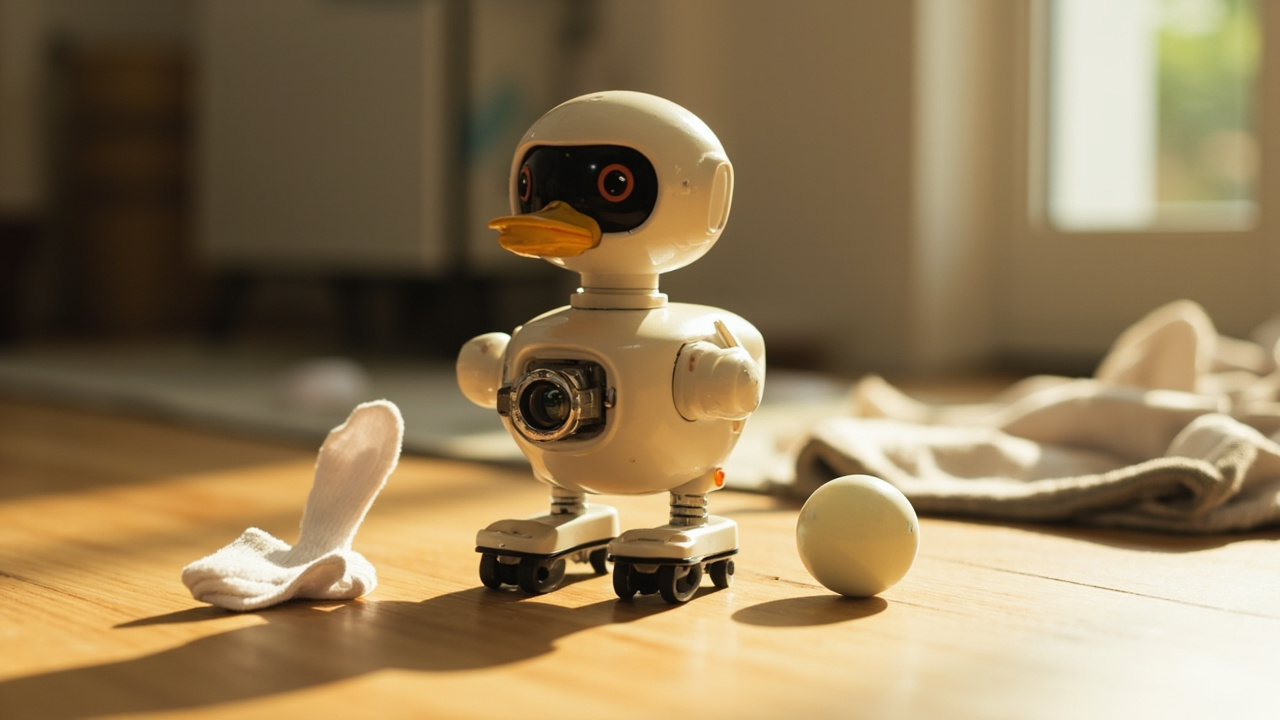
TL;DR: Hugging Face's Pollen Robotics opened $399 preorders on Aug. 27, 2026, for Microduck, a 25-centimeter open-source biped robot that waddles, recovers from falls, grabs with its beak, and roller-skates.
Hugging Face unveiled Microduck on Thursday, Aug. 27, 2026, as its second small AI robot built with Pollen Robotics, according to TechCrunch in “Hugging Face is selling a cute $399 open source duck robot, Microduck.” The machine sells for $399 and is listed for preorder now, with shipping planned before Christmas 2026. The announcement positions the device as an open-source robot owners can teach with reinforcement learning. Hugging Face CEO Clem Delangue described it as an “open-source robot you can teach new tricks with reinforcement learning.”
A second robot after Reachy Mini
Microduck follows the Reachy Mini line that Hugging Face introduced with Pollen Robotics, according to TechCrunch. Hugging Face acquired French startup Pollen Robotics in April 2025 to build affordable, open-source AI hardware. The companies launched Reachy Mini a couple of months later.
The lineup now includes the $499 Reachy Mini powered by a Raspberry Pi computer and the $399 Reachy Mini Lite powered by a Mac or PC, according to TechCrunch. Microduck was imagined as a more action-oriented alternative to the Reachy Mini desktop robot, according to Engadget in “Hugging Face and Pollen Robotics open pre-orders for the $399 Microduck.” Where Reachy Mini was stationary and built around human-robot communication, Microduck focuses on mobility. A Pollen Robotics spokesperson said Reachy Mini sold 3,000 units in its first week and the team hopes Microduck will exceed that figure, according to Popular Science in “Microduck is a robot built to fall down—and learn new tricks.”
Size, colors and duck identity
Microduck stands just under 10 inches tall, or 25 centimeters, according to The Verge in “Hugging Face’s new robot is an adorable rollerskating duck.” It weighs under 800 grams, or about 1.7 pounds, according to Engadget and Popular Science. Popular Science compared the height to a terrier and the weight to roughly the same as a chicken.
The robot is a one-eyed biped, according to The Verge. It is offered in cream, graphite, lavender and sky blue, according to The Verge. Hugging Face said it chose duck branding because it made the most sense given the robot’s proportions, beak and waddling gait, according to Engadget. The company said different colors make several robots standing together look like a collection of different characters rather than identical machines, according to Engadget. The company also said using several robots at the same time internally is about ten times more fun and that the team managed to get them playing soccer together, according to Engadget.
Legs, beak, head and rollerskates
Microduck has 15 motors, according to Engadget. The motors are spread across its legs, head and neck, according to Engadget. The articulated legs, head and neck support walking, sitting and crouching, according to The Verge and Engadget. The machine can walk, sit, crouch, get back up from many common falls, and roller-skate, according to Engadget.
The articulated beak works as a gripper, according to Popular Science. It can pick things up with its beak, according to TechCrunch. Video demos show it picking up socks and markers, according to The Verge. Popular Science said the beak can grab small objects like loose socks. Promotional videos also show the robot kicking a soccer ball around a room, according to Popular Science.
Roller-skating is handled through a roller-skate attachment for extra speed, according to Popular Science. Demo videos show Microduck zipping around on tiny rollerskates, according to The Verge. The company said all of the actions seen in promotional videos, including soccer playing and roller skating, are already programmed and will be available when the robot ships, according to Popular Science. Videos also show Microduck standing back up after lying flat on its back, according to Popular Science.
Camera, LiDAR, motion sensing and onboard hardware
Microduck perceives the world with a camera, lidar sensors and two IMUs, according to TechCrunch. IMUs are inertial measurement units that measure and report movement, according to TechCrunch. The Verge reported a camera, motion sensors and LiDAR. Engadget reported a built-in camera, a small LiDAR sensor and two IMUs.
Tiny LiDAR sensors help keep the robot from bumping into things, according to Popular Science. Onboard sensors help it maintain balance and recover from falls, according to Popular Science. It also has a microphone to hear, according to Popular Science.
The robot runs on a Rockchip RK3566 processor, according to The Verge. It has 32GB of storage and 1GB of onboard RAM, according to Engadget. It supports Wi-Fi and Bluetooth, according to Engadget and Popular Science. The 2,600mAh battery is rated for around one hour of continuous runtime, according to Engadget. Popular Science reported total battery life of about one hour, depending on how it is used. Hugging Face said it aims to dispatch its first round of orders before Christmas in the U.S., according to Engadget.
Creature sounds instead of assistant speech
Unlike Reachy Mini, Microduck does not use words, according to Engadget. It communicates through sound using a built-in microphone and speaker, according to Engadget. Hugging Face asks owners to think of it as a living creature rather than a robot assistant, according to Engadget.
Each Microduck can sing with its own unique generated voice, according to The Verge. Pollen Robotics said it communicates through weird little sounds, closer to a creature than an assistant, according to The Verge. Each Microduck gets its own audio identity the first time it wakes up, tied to that individual robot so it keeps the same voice for life, according to The Verge. When placed next to other Microducks, the robots can sing in unison, according to Popular Science.
Gamepad, laser pointer and out-of-box behavior
Users can control Microduck with a game controller, according to The Verge. It can react to its surroundings and follow around a laser pointer, according to The Verge. Engadget reported that owners can control the robot with a gamepad or have it follow a laser dot right out of the box.
Its pre-learned behaviors mean it reacts to its surroundings and various movement triggers without owners needing to code everything, according to Engadget. Hugging Face co-founder and Chief Science Officer Thomas Wolf said the team is creating a new category of consumer robots that is AI native, playful and also an education tool, according to Popular Science. Delangue said the launch marks the era of open-source affordable robots to democratize physical AI and world models, according to TechCrunch.
Simulation, SDK and retraining loop
The Microduck software is open-source, like the previous Reachy Mini software, according to The Verge. Users can retrain it to do new tricks, according to The Verge. The SDK, simulation and full reinforcement-learning training stack are available on GitHub, according to TechCrunch. The main Microduck repository, available at launch, includes the SDK and robot software, with Microduck RL containing reinforcement-learning tools, according to Engadget.
Behaviors can be trained in simulation and directly deployed on the robot, according to TechCrunch. Developers can then fine-tune the bot, retrain it and redeploy it, according to TechCrunch. Each Microduck has a simulated twin in a virtual world where users can train new movements through reinforcement learning and then transfer those skills to the physical robot, according to Popular Science. The creators said the simulated-twin approach gives owners, including those with beginner-level programming skills, a way to train the robot while learning how AI training works, according to Popular Science. The spokesperson said the best use case will likely come from community creativity after launch, according to Popular Science.
Sources referenced
- Hugging Face’s new robot is an adorable rollerskating duck | The Verge (https://www.theverge.com/gadgets/985549/hugging-face-microduck-robot)