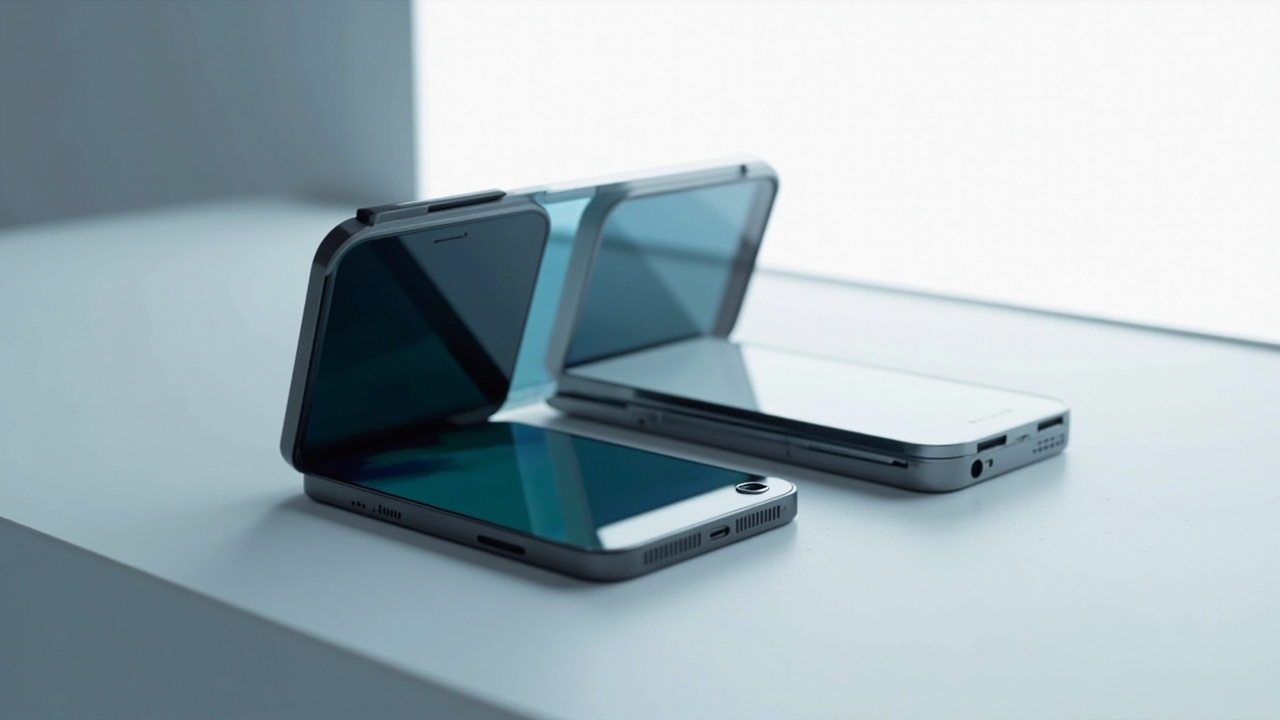
TL;DR: Apple introduced iPhone Duo, its first foldable iPhone, on September 9, 2026, with a 5.4-inch outer display and 7.6-inch inner display, a $1,999 starting price for 256GB, preorders that began October 16, 2026, and store availability planned for October 23, 2026.
Apple entered foldables with a book-style phone after years of rumors, and executives positioned the device as a pocketable phone that opens into a much larger canvas.
Announcement answers years of foldable rumors
Apple introduced iPhone Duo on September 9, 2026, at its headquarters in Cupertino, California, according to Apple and NBC News. The presentation was led by John Ternus, Apple's CEO, in his first iPhone launch event in that role, according to NBC News.
The company described Duo as the first foldable iPhone, according to Apple. The device arrives more than seven years after the first Samsung Galaxy Fold phone reached the market, according to The Verge. Ternus said in the livestreamed event that other foldables feel like two phones awkwardly stuck together, while Duo has a larger display that feels as natural and intuitive as iPad, according to NBC News.
In a press release quoted by The Verge, Ternus said:
iPhone Duo is the most transformational change to iPhone since the original.
He also said the phone combines the largest display ever on iPhone with pocketable size and A20 Pro power for content, multitasking and gaming, according to The Verge.
Wall Street investors appeared to shrug at the announcement, which had been widely expected, with Apple shares down 1.9% in afternoon trading on announcement day, according to NBC News.
Two screens share one aspect ratio
Duo uses two Super Retina XDR displays, according to Apple. Closed, it has a 5.4-inch outer display. Opened, it has a 7.6-inch inner display, described as the largest display on any iPhone yet, according to The Verge and Apple.
Apple said the closed device is similar in size to a passport and comfortable for one-handed use, according to Apple and NBC News. The outer display provides 90 percent of the screen area of iPhone 18 Pro, according to Apple. The inner display is 50 percent larger than iPhone 18 Pro Max and 80 percent bigger than iPhone Pro, according to The Verge.
Both screens use the same aspect ratio, so content scales proportionally between closed and open states, according to Apple. Both support ProMotion, Always On displays and up to 3,000 nits of peak brightness, according to The Verge. Apple said Apple Pencil support is coming later this year, with later product details specifying Apple Pencil with USB-C on either display, according to The Verge and Apple.
The Verge's roundup noted a flashy opening animation when the phone unfolds, with content gradually coming into focus as the screens transition rather than simply switching one display off and the other on.
Nano-texture aims to hide the crease
Apple emphasized crease visibility, glare and touch feel on the folding inner screen, according to The Verge. Johny Srouji, Apple's chief hardware officer, said the company did not want a crease or plastic feel, so it used a custom nano-texture display material that is perceptually flat, according to The Verge.
Apple said the premium nano-texture finish reduces glare and reflections, creates a matte surface, minimizes crease visibility and feels great to touch, according to The Verge and Apple. Beneath the surface, a multilayer display stack uses custom adhesives that allow layers to glide past one another like pages of a book, relieving bend stress and reducing how much the crease deepens and distorts over time, according to Apple and The Verge.
The inner screen is made of more than 10 ultrathin layers, according to Apple. Apple also described high-strength glass above and below the folding panel, a scratch-resistant coating, a custom polymer cover layer with up to 40 percent higher stiffness than other materials used in the industry, and a titanium plate at the bottom of the stack, according to Apple.
Hands-on impressions published by The Verge said the inner screen had a decidedly matte finish that handled glare from windows above the hands-on area well, with a smooth folding mechanism and a crease almost impossible to find by finger.
Titanium body, hinge and durability ratings
The frame is primarily grade 5 titanium, polished to a mirror finish, according to Apple and The Verge. Internal ceramic fibers strengthen the frame, while antenna splits with ceramic fiber inserts enhance rigidity, according to The Verge and Apple.
Apple described a precision hinge with more than 100 components, support ribs for stiffness, a 3D-printed hinge cover with contrasting micro-blasted finish, center-display support to hold the screen flat, and an integrated magnet array for satisfying and secure closure, according to Apple.
The rear uses Ceramic Shield glass and the front uses Ceramic Shield 2, with Apple saying Ceramic Shield 2 has three times better scratch resistance than the previous generation, according to The Verge and Apple. The phone has an IP68 rating for splash, water and dust resistance, according to Apple.
Duo launches in two colors: star white and night sky, a dark blue, according to The Verge and Apple. It measures 5.2 mm thick when open and 11.3 mm when shut, making it thicker than Samsung's similar foldables and most other recent Android models, according to The Verge.
A20 Pro, vapor cooling and dual batteries
Like the 18 Pro and Pro Max, Duo is powered by Apple's A20 Pro chip and C2 modem, according to The Verge. The 2-nanometer, six-core A20 Pro has two desktop-class super cores, described by Sribalan Santhanam, vice president of silicon engineering, as by far the fastest in any smartphone, plus four performance cores, a seven-core GPU and two neural engines in a 32-core NPU, according to The Verge.
A new vapor chamber three times the size of the previous generation helps maintain thermal performance, according to The Verge. Apple also described an advanced thermal management system with a custom-designed vapor chamber, according to Apple.
Apple did not adopt silicon-carbon batteries used in Samsung's new foldables, according to The Verge. Instead, Duo uses a dual-battery architecture with one battery on each side operating as one system, according to The Verge and NBC News.
Apple estimated 24 hours of regular use, up to 31 hours of video playback on the larger inner screen, up to 44 hours when using the outer display, and 24 hours when using both screens equally, according to The Verge, Apple and NBC News. Wired charging returns 50 percent of battery in 20 minutes, or in half an hour over wireless or 25W MagSafe, according to The Verge.
Cameras add foldable-specific shooting modes
Duo has a dual rear camera with both lenses using 48-megapixel sensors, including a 48-megapixel Fusion Main camera and 48-megapixel Fusion Ultra Wide camera, according to The Verge and Apple. The ultrawide is the same camera found on the 18 Pro, according to The Verge.
It lacks the variable-aperture main camera and pro controls of the 18 Pro phones, but includes the same Photographic Styles updates for tweaking textures and grain, according to The Verge. Video capture reaches up to 4K at 120 frames per second, according to Apple.
Foldable-specific features include taking a FaceTime call on both sides at once in group settings, previewing selfies taken with the main cameras on the outer screen, and Smart Take, which can automatically take photos once it detects a pose within the frame, according to The Verge. Apple also listed Duo Preview, Kid Cue and Duo FaceTime among camera and calling features, according to Apple.
The front screen has a selfie camera tucked into a rounded corner with Center Stage support, while the inner screen uses an under-display FaceTime camera that stays hidden when not in use, according to The Verge and Apple.
Touch ID replaces Face ID
Duo does not include the usual Dynamic Island or Face ID cameras, according to The Verge. Instead, Touch ID is integrated into a side button for consistent authentication whether open or closed, according to Apple and NBC News.
Apple Watch users can also unlock Duo with their watch, according to The Verge and Apple. The design includes Camera Control for launching the camera, including a Siri Camera mode that lets Siri see what the user sees to answer questions and take action, according to Apple.
Craig Federighi, Apple's senior vice president of software engineering, said users can use Duo in any orientation or pose, including setting it on a table to watch a show hands-free on the outer display without a stand, according to NBC News. When folded, Duo looks like a large D with two rounded edges, a shape one presenter said invites you to open it, according to NBC News.
iOS 27 moves the dock and status controls
Apple paired Duo with software updates in iOS 27 designed for foldable use, according to The Verge. Apps and content expand as the screen opens or closes, including two-app multitasking and Split View with two apps side by side or two windows of Safari, according to The Verge and NBC News.
Core controls stay consistent in either orientation, according to The Verge. The home screen dock moves to a vertical bar on the right-hand edge, along with app navigation controls and the Dynamic Island, according to The Verge. The status bar is condensed into a small, expandable circle in the top-right corner, according to The Verge.
Other Duo behaviors include pinning videos to the top while using another app, viewing two websites at once, laptop mode with media on the inner screen and controls on the lower half, tent mode, and StandBy even when not plugged in, according to The Verge and Apple. Apple said Netflix, Zoom and Slack had already launched updates to take advantage of Duo features, according to The Verge.
Price, preorders, launch date and repair costs
Duo starts at $1,999 for 256GB, with options up to 2TB total, according to The Verge and Apple. That starting price is $100 more than Samsung's Galaxy Z Fold 8 but $100 less than its Z Fold 8 Ultra, according to The Verge. Like iPhone Air, Duo is eSIM-only worldwide, according to The Verge.
Preorders began Friday, October 16, 2026, at 8 a.m. ET / 5 a.m. PT, with availability beginning Friday, October 23, 2026, a month later than the two 18 Pro models, according to The Verge, Apple and NBC News. Availability on October 23 is a planned future launch relative to preorder week.
Before preorders opened, Apple's product page let shoppers select color, storage, carrier preference and trade-in setup, leaving the configuration in the cart for confirmation on preorder morning, according to The Verge. The Verge reported on October 16, 2026, that Apple described preorder demand as extraordinary.
Repair costs without AppleCare Plus are unusually high for the folding display, according to The Verge. Apple published estimated costs of $49 for cover-layer damage, $199 for back glass, $229 for battery service, $229 for rear-camera damage, $379 for outer-display damage, $509 for outer display plus back glass, $999 for inner-display damage and $1,499 for other damage, according to The Verge.
With AppleCare Plus, battery service is $0, inner-display repair is $99 and other accidental damage is $99, according to The Verge. AppleCare Plus with Theft and Loss for Duo costs $19.99 per month, $199.99 per year or a flat $399, according to The Verge.
Sources referenced
- Apple unveils iPhone Duo - Apple (https://www.apple.com/newsroom/2026/09/apple-unveils-iphone-duo/)
- The iPhone Duo is Apple’s first foldable | The Verge (https://www.theverge.com/tech/991203/iphone-duo-foldable-news-specs-price-release-date)