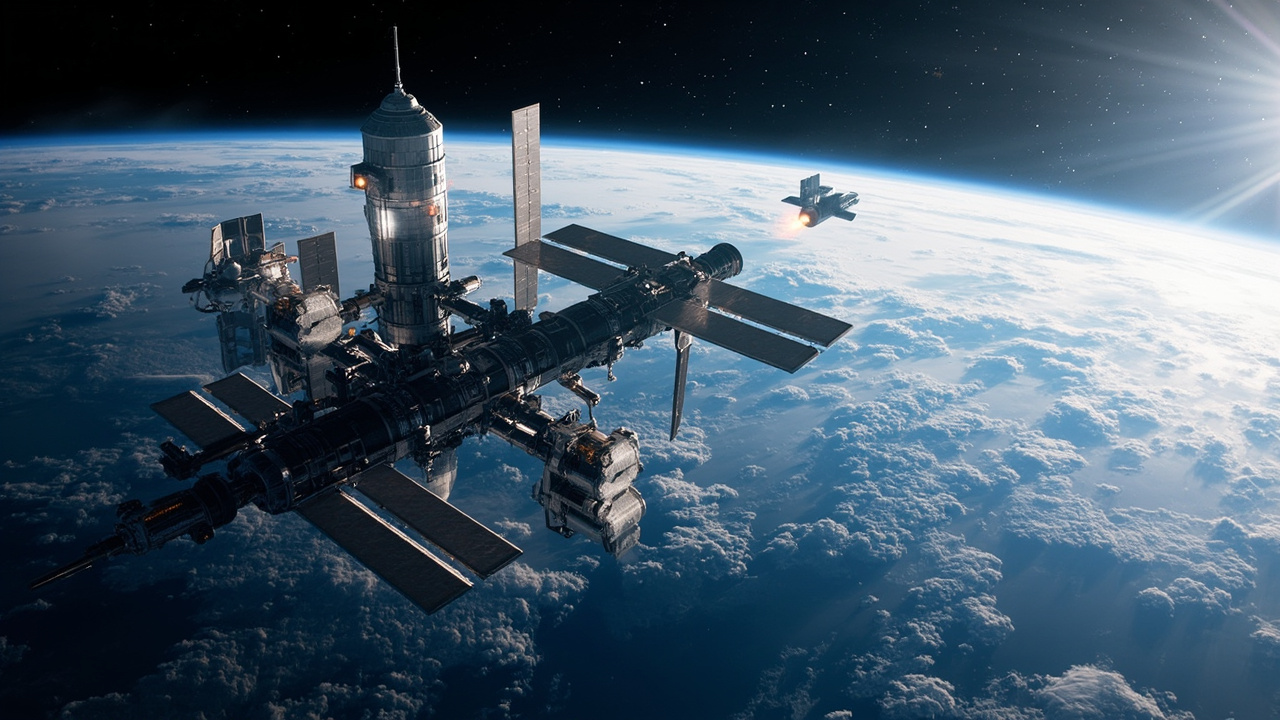
TL;DR: NASA has issued its long-awaited industry solicitation for commercial space stations to succeed the International Space Station in low Earth orbit.
NASA has taken the decisive step commercial spaceflight companies have waited years to see. The agency released a formal call to U.S. industry for proposals to develop and operate private space stations, setting in motion the procurement that will determine where NASA astronauts live and work after the International Space Station era.
The release, reported on Oct. 10, 2026, by Ars Technica, marks the transition from early design studies and funded concept work to a concrete commercial-services competition. According to Ars Technica, the announcement outlines how NASA intends to become an anchor customer on one or more commercially owned and operated destinations rather than owning the next station itself. Additional context on agency plans for low Earth orbit commercialization is available from NASA.
What NASA announced
The solicitation invites American companies to propose commercial destinations in low Earth orbit capable of supporting NASA crew, research, and technology demonstration needs. In practical terms, it asks industry to explain what it will build, when it can fly, what it will cost NASA to use, and how safety and reliability will be assured.
According to Ars Technica, the long delay before this release reflected budget uncertainty, changing requirements, and debate inside NASA and Congress about how many providers to support and how quickly to move away from the International Space Station. The publication of the call signals that those internal trades have now been settled enough to let companies bid.
NASA has consistently described its future role as one customer among many on private stations. The agency does not plan to procure the stations themselves as government-owned hardware. Instead, it plans to purchase crew time, cargo delivery, research volume, and operational services, much as it now purchases crew transportation from commercial providers for flights to the International Space Station.
That distinction matters for both cost and control. Ownership, maintenance, upgrades, and commercial marketing would rest with the private operator. NASA would define high-level certification and safety requirements, verify compliance, and then buy missions rather than managing day-to-day station operations.
Why the timing is critical for the ISS transition
The International Space Station has been continuously crewed for more than two decades and remains the primary U.S. laboratory in orbit. But its hardware is aging, maintenance demands are growing, and its operational horizon is limited. NASA and its international partners have been planning for a controlled transition to commercial platforms through the end of the decade.
According to Ars Technica, industry officials had grown concerned that further delays in the final solicitation could create a gap in U.S. human presence in low Earth orbit. Developing, launching, assembling, and certifying a crewed station typically takes years, even when building on existing modules, spacecraft, and launch vehicles.
A gap would carry scientific, industrial, and geopolitical costs. Microgravity research, biomedical studies, materials science, Earth observation technology tests, and in-space manufacturing demonstrations that now rely on the International Space Station would have nowhere to go. Commercial crew and cargo vehicles would lose their primary destination. Partner agencies that depend on NASA leadership in low Earth orbit would face their own planning disruption.
The solicitation is therefore intended to give NASA and bidders a firm schedule. The agency can evaluate competing architectures side by side, select one or more providers for further development and demonstration, and preserve overlap between the International Space Station and its successors if development stays on track.
Who is expected to compete
NASA has not pre-selected winners, and the solicitation is open to qualified U.S. industry teams. But the field of likely bidders has been forming in public for several years through NASA-funded design awards, unfunded partner agreements, hardware tests, and independent commercial announcements.
Axiom Space is widely viewed as an early contender. The Houston-based company has been developing a commercial segment initially attached to the International Space Station, with a plan to eventually detach as a free-flying station. It has already flown private astronaut missions to the station and has discussed manufacturing, research, and national-astronaut customers.
Another team centers on Starlab, a commercial station concept associated with Voyager Space and Airbus. The project has evolved through several partnerships and design iterations, emphasizing a large-diameter habitat launched in a single flight, with research and industrial users alongside NASA.
A third major concept has been Orbital Reef, led by Blue Origin with Sierra Space and other partners. That design envisions a modular business-park approach with multiple ports, shared utilities, and a mixed crew-and-cargo traffic model supported by new heavy launch and in-space transportation systems.
Other aerospace contractors, startups, and supplier teams may bid as primes or join these groups. Large integrators with human-spaceflight heritage, life-support expertise, docking systems, robotics, and mission operations experience could play major roles even if they do not lead a proposal. According to Ars Technica, the structure of the solicitation will help determine whether smaller firms can compete directly or must join larger teams.
How the procurement is structured
While full proposal instructions are contained in the federal solicitation documents, the model described by Ars Technica follows NASA's recent commercial-services approach. NASA sets performance goals and safety thresholds, industry proposes designs and business plans, and the agency funds milestones tied to demonstrated progress.
Key elements expected in the competition include technical maturity, safety and crew-health provisions, docking and visiting-vehicle interfaces, power and communications capacity, research accommodations, operational cadence, and plans for disposal at end of life. Bidders will also need to show how they will attract non-NASA customers, because long-term viability depends on diversified revenue.
Cost realism will be central. NASA has limited funds for both International Space Station operations and commercial-station development during the transition period. Proposals that require excessive agency funding, underestimate integration challenges, or depend on unproven revenue streams are likely to face scrutiny.
Certification is another central issue. Any station hosting NASA astronauts must meet human-rating standards for structures, life support, fire safety, emergency return, radiation protection, and medical capability. NASA is expected to phase certification work so that critical safety systems are proven before crew arrive for long-duration stays.
According to NASA, commercial low Earth orbit development is intended to maintain uninterrupted U.S. capability while enabling a broader economy in orbit. The agency has said it wants competition to control costs and encourage innovation, rather than locking in a single government-designed replacement.
What it means for research and astronauts
For scientists, the shift from a government laboratory to commercial platforms could change how experiments are proposed, scheduled, and priced. Principal investigators accustomed to International Space Station processes may need to work through commercial operators, with NASA acting as a broker for agency-sponsored research.
For NASA astronauts, the change is cultural as well as logistical. Crews trained for International Space Station systems will need to qualify on new habitats, life-support architectures, hatch designs, robotics, and emergency procedures. Mission durations, crew size, spacewalk capability, and cargo return options could differ from station to station.
For commercial users, a NASA anchor tenancy could lower the barrier to entry. Pharmaceutical research, semiconductor crystal growth, fiber-optic manufacturing, Earth-imaging calibration, and entertainment projects have all been discussed as potential markets. None has yet demonstrated demand sufficient to sustain a station alone, which is why continued government demand remains important in the near term.
The solicitation also affects launch providers, spacesuit developers, cargo-vehicle operators, and ground-control contractors. A new station creates demand for regular crew rotation, resupply, reboost, debris-avoidance maneuvering, communications relay, and payload integration services.
What to watch next
The next milestones will be procedural but revealing. NASA will hold an industry briefing, accept written questions, amend the solicitation if needed, and set a proposal due date. The number and composition of bidding teams will indicate industry confidence in the business case and schedule.
After proposals are evaluated, NASA is expected to make one or more awards for further development, followed by demonstration milestones and, eventually, crewed certification flights. Funding profiles in future budget requests will show how seriously the agency and the White House prioritize avoiding a coverage gap.
Congressional reaction will also matter. Lawmakers who oversee NASA appropriations have historically weighed jobs, international commitments, safety, and competition policy in station decisions. Their support will influence whether NASA can fund multiple providers or must downselect quickly.
International partners are watching as well. The European Space Agency, the Japan Aerospace Exploration Agency, and the Canadian Space Agency rely on the International Space Station partnership. Their future participation in commercial stations, as customers or hardware contributors, could expand the market and strengthen interoperability standards.
For now, the message to industry is clear: the waiting period is over, and the competition to build America's next home in low Earth orbit has formally begun.