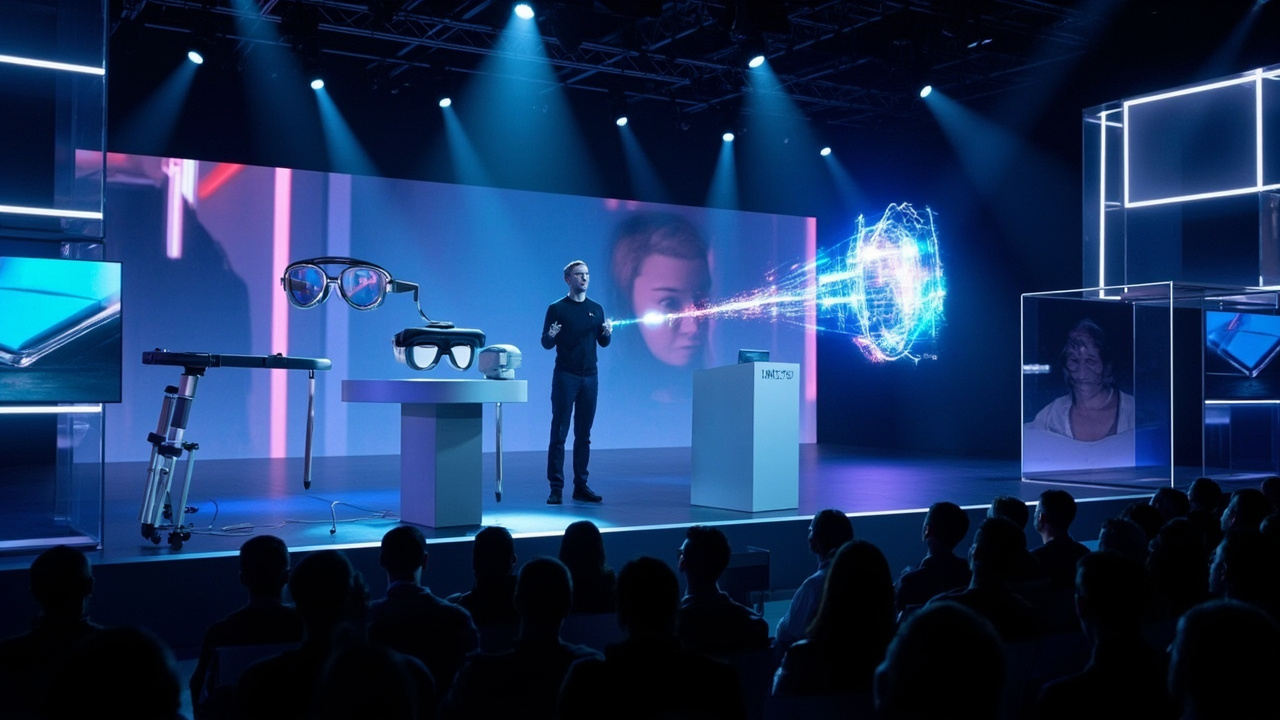
TL;DR: Meta used its Connect keynote on September 23, 2026, to introduce Meta VR Glasses for next spring at $1,300, Ray-Ban Meta Audio for October 13 at $349, and Ray-Ban Meta Gen 3 available that day at $449, alongside Muse Charm and major Muse AI expansions.
Meta CEO Mark Zuckerberg led the annual keynote from the company's headquarters in Menlo Park, California, according to Tom's Guide. The presentation started at 4 p.m. PT and streamed on Meta.com and YouTube. Business Insider reported that the event followed the recent launch of Muse, described as an App Store-topping AI assistant. Zuckerberg described one of the new devices during the keynote by saying there was nothing else like it and calling it a glimpse of the future, according to Business Insider.
1. Meta VR Glasses arrive next spring for $1,300
The largest hardware introduction was Meta VR Glasses, a tethered virtual-reality device designed to look and wear more like glasses, according to Engadget. Meta plans to release the device next spring for $1,300, with Tom's Guide listing the price at $1,299.
Meta said the glasses weigh around 100 grams and are five times lighter than the Meta Quest 3 headset, according to Engadget. Business Insider similarly reported that Zuckerberg said the device weighs one-fifth as much as the Meta Quest. The frames use magnesium alloy and pancake lenses, according to Engadget.
The company described cinema-grade clarity with a 5K display, full-color passthrough video, Dolby Vision support and Dolby Atmos spatial audio, according to Engadget. Meta also called the product the first IMAX Enhanced certified VR device, according to Engadget. In its own recap, Meta described the device as delivering an IMAX-grade cinema experience and full spatial computing.
All computing is handled by a tethered puck containing storage and battery power, according to Engadget. The system runs on Qualcomm's Snapdragon Reality Elite chipset. Meta said the glasses will provide up to three hours of continuous high-resolution media playback and that the puck supports 45W fast charging, according to Engadget.
For games, Meta plans 75 titles playable with hand gestures at launch, according to Engadget. The glasses will run games available for Quest headsets with support for Touch Plus controllers. Users will also be able to stream through Xbox Cloud Gaming, connect other gaming devices wirelessly or through USB-C, and use the glasses for Windows PC and Mac productivity with a virtual keyboard and touchpad or physical controls, according to Engadget.
Video calling will include holographic avatars for apps including WhatsApp and Zoom, according to Engadget. People joining from a flatscreen device can see the hologram, while spatial audio positions another person's voice in their virtual location for the glasses wearer. Control options include voice through Meta AI, eye control and hand gestures, according to Engadget.
2. Ray-Ban Meta Audio brings camera-free glasses on October 13
Meta introduced Ray-Ban Meta Audio as its first audio-only glasses model, according to Tom's Guide. Pre-orders opened September 23, with shipments scheduled for October 13 and pricing starting at $349, according to Engadget.
The glasses support music and podcast playback, voice calls and an AI voice assistant, according to Engadget. Meta estimated up to 12 hours of use on a charge, while the charging case adds up to 48 hours of use, according to Engadget. Meta described the model as its slimmest and lightest frame yet in its own announcement.
The device weighs 43 grams and includes adjustable temple tips, adjustable or swappable nose pads and overextension hinges, according to Engadget. It will be offered in Clubmaster and the more rectangular Burbank shapes, with 23 color and lens combinations, according to Engadget. Prescription-lens support is included, and Meta said the glasses are compatible with a wide range of optical prescriptions.
3. Ray-Ban Meta Gen 3 goes on sale starting at $449
The third-generation Ray-Ban Meta camera glasses went on sale September 23 in 27 lens and color combinations starting at $449, according to Engadget. Tom's Guide likewise listed the model as available that day at the same starting price.
The refresh has a slimmer design and a dedicated action button for faster access to Meta AI and other functions, according to Meta and Engadget. Battery life rises to nine hours from eight hours on the prior model, according to Engadget. Meta called it the longest battery life of any Ray-Ban Meta model.
The glasses include a six-microphone array that Meta said can remove more than 90 percent of background noise, according to Engadget. The 12-megapixel camera supports 3K video capture. Meta said cameras on its AI glasses will soon record video with Dolby Atmos spatial audio, according to Engadget. A dynamic-photo feature captures multiple images so the wearer can select the best image or accept a Meta AI suggestion, according to Engadget.
New frame choices include Ray-Ban's Aviator silhouette and Zena, a cat-eye design, alongside the continuing Wayfarer look, according to Engadget. A limited-time Aviator version in milky beige with brown Transitions lenses starts at $579, according to Engadget.
4. Muse Charm puts the assistant in a pocket device
Meta introduced Muse Charm as a small pocketable device for talking with Muse, according to Meta. Tom's Guide described it as a pendant-style device that holds an AI agent and can attach to a keychain.
The device uses a real-time voice model for interaction with Muse, according to Meta. Meta said it will share more details later this year. Tom's Guide reported that Muse Charm is planned for availability this fall, with pricing not yet announced.
5. Muse AI gains voice design, avatars, glasses access and shopping connectors
Meta said Muse, introduced only weeks earlier, would gain real-time voice conversation, visual embodiment and broader device access, according to Meta. The voice mode supports extended conversations while Muse continues work in the background, according to Meta. Users can design a Muse voice by describing characteristics including speed and accent, according to Meta.
Meta Superintelligence Labs is introducing Muse Realtime Avatar, technology that converts Muse Realtime Voice into expressive interactive avatars, according to Meta. Users will also be able to customize an avatar's appearance, name and speech style, according to Tom's Guide.
Muse is coming to AI glasses in the coming months for hands-free use activated by speaking the agent's name, according to Meta. Muse will be able to use the wearer's view for assistance, including identifying a product on a shelf, reading a flier or handling a list of school supplies, according to Meta. Current access points include the Muse app, WhatsApp, the web and a recently launched Mac desktop version that can manage messages and locate files, according to Meta.
Muse will also receive its own email address for completing tasks and communicating with users, according to Meta. On Mac, computer-use functionality allows Muse, with permission, to operate applications and continue lined-up tasks while the user is away, according to Meta.
Shopping and productivity integrations are expanding significantly. Meta launched Muse with dozens of partners and access to the Shopify catalogue, according to Meta. New shopping additions include Walmart, Best Buy, American Eagle Outfitters, DICK'S Sporting Goods, Fanatics, Gap, Michael Kors, Sephora, Ulta and Wayfair, with Shop Pay and PayPal for payments, according to Meta. Expedia is coming soon for travel planning, Instacart is available for grocery stocking, and work connectors include Notion, Granola, GitHub and Box, according to Meta. Tom's Guide also reported Walmart and Instacart among the retail integrations.
6. FDA-approved hearing assistance comes to select glasses
A hearing-enhancement feature will arrive later this year on select smart glasses, according to Tom's Guide. The feature is described as FDA-approved over-the-counter software intended to assist adults with mild to moderate hearing loss.
The offering will cost $149 per year or be included with a Meta One subscription, according to Tom's Guide. Engadget also identified hearing assistance as one of the new glasses-related announcements at the event.
7. Display, personalization and entertainment expand the glasses platform
Meta said it will broaden its AI-glasses lineup to more than 100 options by the end of the year across Ray-Ban, Oakley and Meta Glasses, according to Meta. New Meta Glasses styles include an Ivory version from Kylie Jenner, a first collaboration with LISA, additional Capri and Nova shapes, a lower-cost Adventurer and a limited-edition Fury available only at Meta Lab locations at launch, according to Meta. Engadget reported that Adventurer frames start at $249 with a black frame, gray lenses and plug-in case, while the Fury has a clear frame and mirrored lenses. Collaboration models with Kylie Jenner and Blackpink's Lisa start at $399, according to Engadget.
A Mix & Match program in the United States allows buyers to customize frame, lens and case colors, according to Meta. Meta Glasses became available September 23 in Singapore, South Korea and Mexico, with Brazil and the United Arab Emirates coming soon, according to Meta.
Meta Ray-Ban Display glasses will add cycling and public-transit directions plus real-time transit departures later in September in the United States and Canada, according to Tom's Guide. WhatsApp video calls from the Display glasses will support a holographic facial model that moves as the wearer speaks, created by using Muse AI to capture the face, according to Tom's Guide. Meta plans Early Access in the United States later in the fall.
Business Insider reported that Meta also promised VR-immersive environments tied to Disney franchises and pointed to the dedicated Muse button as a way to keep the assistant available. Engadget reported upcoming entertainment additions including major changes for Beat Saber and additional content for the VR ecosystem.
Sources referenced
- Everything We Announced at Meta Connect 2026 - Meta (https://www.meta.com/blog/meta-connect-2026-everything-we-announced/)
- Everything announced at Meta Connect 2026 - Engadget (https://www.engadget.com/2267230/everything-announced-at-meta-connect-2026/)