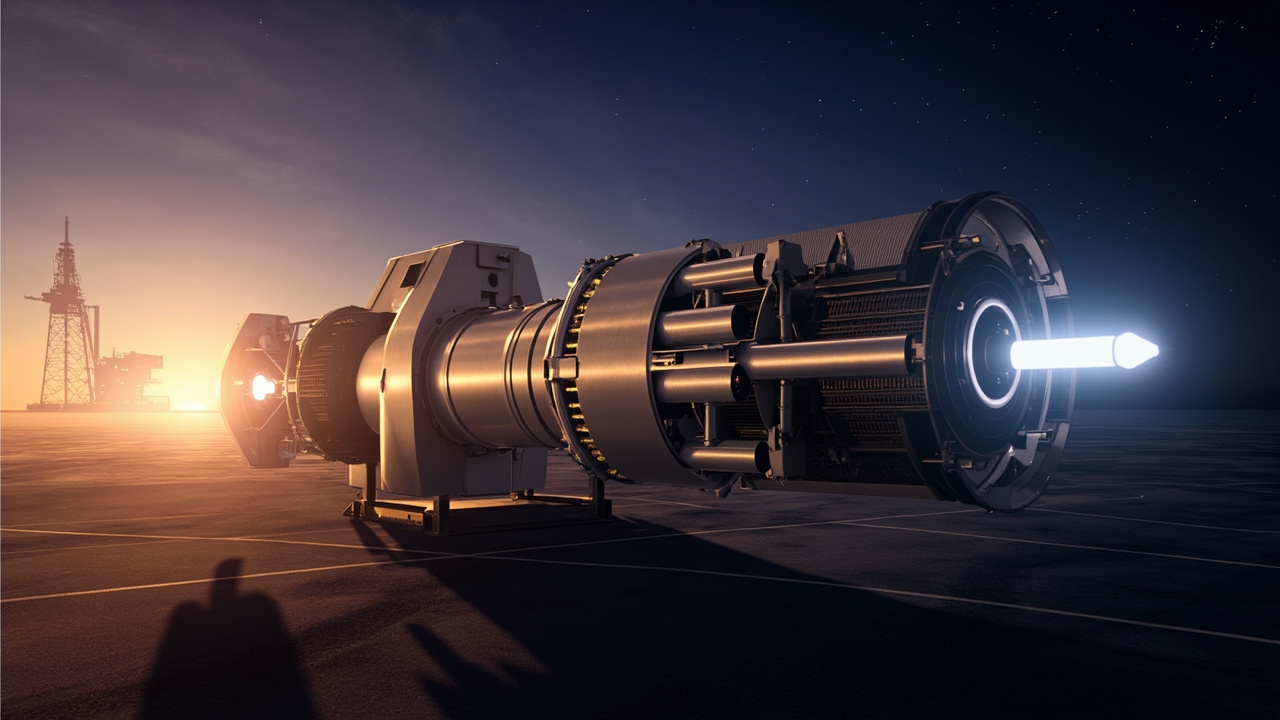
Blue Origin's Northstar Engine: What Was Announced
Blue Origin's new Northstar rocket engine will deliver 715,000 pounds of thrust at roughly one-quarter the manufacturing cost of the BE-4 engine it is designed to replace on the New Glenn rocket. The company made the announcement on November 5, 2026, at the Up.Summit conference, where CEO Dave Limp presented the engine's specifications alongside a new third stage for New Glenn called the GS3.
The Northstar engine produces 75,000 more pounds of thrust than the BE-4, cuts vehicle mass by 30 percent, and reduces total part count by half, according to Ars Technica's coverage of the Up.Summit announcement. Limp described demand for launch capacity as unprecedented and said those economics are what drove the decision to pursue a fundamentally redesigned engine.
How Northstar Is Built
More than 65 percent of Northstar's components are produced using additive manufacturing, a shift that Blue Origin says compresses the assembly process enough to build one complete engine in less than a single day. At that production pace, the company is targeting a cadence of one engine approximately every ten days.
Northstar uses a liquid oxygen and liquefied natural gas (LOX/LNG) propellant combination, the same pairing used in the BE-4. The engine retains an oxygen-rich staged combustion cycle and a single-shaft turbopump architecture, design choices Blue Origin carried forward from its earlier work. The additive manufacturing approach reduces part complexity without abandoning the core thermodynamic cycle that has defined the company's high-thrust propulsion systems, as reported by Spaceflight Now in its coverage of the Up.Summit reveal.
The cost target—roughly 25 percent of what BE-4 production costs—is the headline claim Blue Origin attached to the program. The company has not disclosed an independent cost audit, and the figure represents an internal projection stated by Limp at the conference rather than a verified third-party finding.
The GS3: A New Third Stage for New Glenn
Alongside the engine announcement, Blue Origin revealed the GS3, a third stage designed to bolt onto New Glenn and open mission profiles that the existing two-stage configuration cannot reach. According to Spaceflight Now, the GS3 can carry up to 14 metric tons to geostationary orbit and is intended to support direct deployment missions to a range of high-energy destinations.
The GS3 is powered by Blue Origin's BE-7 engine, the same engine the company developed for its lunar landers. Limp stated that a government mission to cis-lunar space using the GS3 is planned for 2028. That flight had not taken place at the time of the announcement; the 2028 date represents a plan stated by the company at the conference.
The combination of GS3 and Northstar is meant to give New Glenn flexibility across commercial satellite delivery, government deep-space missions, and high-inclination orbits that require significant delta-v beyond what a two-stage vehicle provides. Blue Origin framed the additions as part of a broader propulsion portfolio spanning booster, upper-stage, and in-space engines.
Context: Where This Fits in the Launch Market
The BE-4 currently powers the first stage of New Glenn and also the United Launch Alliance Vulcan Centaur. Blue Origin has been manufacturing the BE-4 for both customers, and any transition to Northstar on New Glenn's first stage would represent a significant production shift. Blue Origin did not announce a specific date for Northstar's first flight on a New Glenn vehicle at the Up.Summit event.
Ars Technica noted that Northstar's specifications place it in direct competition with the trajectory SpaceX has pursued by using high-cadence, additive-manufacturing-heavy production for its Raptor engine. The launch market has seen rapid growth in satellite constellation deployments and government missions, and both companies have cited that demand as justification for investing in lower-cost, higher-throughput engine manufacturing.
Blue Origin's stated ambition, as relayed by Limp, is to enable more than 1,000 launches per year as the broader industry scales. Northstar and GS3 together represent the company's answer to how it intends to participate in that volume—by lowering the per-unit cost of propulsion hardware and broadening the mission envelopes New Glenn can serve.
What the Specifications Mean in Practice
A 30 percent mass reduction on an engine that produces more thrust than its predecessor improves the rocket's payload fraction—more of the vehicle's liftoff mass translates into useful cargo rather than engine hardware. Halving the part count lowers both assembly labor and the number of potential failure points, two factors that affect both cost and reliability over a large fleet.
Building more than 65 percent of parts through additive manufacturing also shortens the supply chain. Traditional subtractive machining of complex turbopump components can require long lead times; printing those parts in-house or through a tighter additive network is how Blue Origin says it arrives at the sub-one-day assembly claim.
Spaceflight Now reported that the GS3 stage's 14-metric-ton GEO capacity would make New Glenn competitive for the heaviest commercial communications satellites, a market segment currently served by a small number of vehicles worldwide.
What Comes Next
Blue Origin has announced both the Northstar engine and GS3 stage as development programs. The company has stated performance targets and a 2028 cis-lunar mission date as forward-looking plans. Neither had flown as of the Up.Summit announcement. Independent verification of the cost and performance figures will come only after hardware testing and eventual flight data become available.